

Ancient Egypt, the cradle of civilization, continues to capture the imagination of the entire world. This article provides a glimpse into the heart of this extraordinary culture, exploring its key aspects. We enter the complex web of polytheism that shaped Egyptian beliefs, unravel the intricate tapestry of mythology and religion, and journey through the significant historical eras that have defined this enduring civilization. Prepare to be transported back in time as we embark on this exploration.
The following concepts lie at the foundation of ancient Egyptian religion:
- Polytheism - the belief in a large number of gods and goddesses. The number of deities varied over time, but some were constantly worshipped.
- The afterlife - belief in an afterlife is central to Egyptian religion. They believe in eternal existence and death is seen as a transition to the next world.
- Maat - The concept of Maat, which means truth, justice and harmony, is essential for the maintenance of cosmic order and is closely related to religion.
All the phenomena that the ancient Egyptians could observe are refracted through the prism of their beliefs. The most important thing for them was to study the different cycles:
- the cycle of days and the Sun, reborn every morning,
- the annual cycle with the tide of the Nile,
- the cycle of life with birth followed by death.
Egyptian beliefs have evolved over about three millennia and have changed over time.
The importance of polytheism
The ancient Egyptians were known for their rich and complex religious system, a polytheistic belief structure encompassing multiple gods and goddesses. Polytheism, the worship of many deities, was not simply a matter of faith but a reflection of deeply rooted aspects of nature and society in ancient Egypt.
Each deity has specific roles and symbolic representations, often related to natural phenomena, human emotions, or abstract concepts. For example, Ra is the sun god, symbolizing light and growth, while Isis represents motherhood and magic. This pantheon of gods provided an overall framework through which Egyptians understood the world around them. The diversity in their gods allows for a nuanced interpretation of the natural world, with each deity controlling different aspects of life and the environment.
The importance of polytheism in ancient Egypt extends to their understanding of the afterlife. Gods such as Osiris and Anubis were central to their beliefs about death and the journey of the soul. This belief system offers a sense of continuity and stability that is essential in a world where the annual flooding of the Nile dictates the rhythm of life and death.
The role of mythology and religion in ancient Egyptian society
Mythology and religion in ancient Egypt were deeply intertwined, shaping every aspect of society. Myths were not just stories, but explanations of the world that defined the moral and ethical codes of the time. They played a crucial role in the cultural and spiritual life of the Egyptians, influencing art, architecture, and everyday practices.
Pharaoh, considered a divine being, was the bridge between the gods and the people. This relationship was vital in promoting Maat, ensuring a stable society by helping the gods prevent chaos.
Religious festivals and rituals were a significant part of Egyptian life, often involving elaborate ceremonies and offerings to the gods. These events had multiple purposes: they were a means of securing divine favor, a way to demonstrate the power and piety of the pharaoh, and an opportunity for community gathering and social cohesion.
Temples, centers of worship and religious activity, were not only places of prayer but also served as cultural, economic, and political centers. Priests and priestesses played essential roles, performing rituals, managing the wealth of the temple, and serving as intermediaries between the gods and the people.
Historical Ages of Ancient Egypt
Gods of the early dynastic period (c. 3150 - c. 2613 BC)
Noon: the primordial, primordial ocean responsible for the creation of the world.
Atum: The creator god, often associated with the sun and primordial life. Son of Nun.
Ra: The sun god, one of the most important deities, often depicted with a falcon's head and a sun disk. Son of Nun.
Shu and Tefnut: Deities of air and moisture, children of Atum.
GebThis entry was posted in God of Earth and Fertility.
Nut: Goddess of Heaven
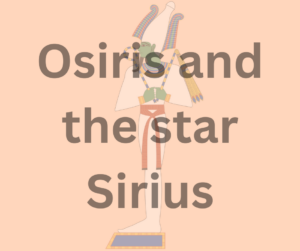
Osiris: God of the afterlife, the underworld and reincarnation. Depicted as a mummified king.
Isis: Goddess of magic, marriage, healing and protection. Known for her devotion to her husband Osiris.
Seth: God of chaos, storms, desert, war. He is often depicted with a unique animal form, resembling a combination of real animals.
Nephthys: Goddess of the Rivers
Chorus: God with the head of a falcon, closely related to Pharaoh and heaven.
Anubis: God of mummification and the afterlife, depicted as a man with the head of a jackal.
Gods of the Old Kingdom (c. 2613 - c. 2181 BC)
Ptah: creator god and patron of craftsmen.
Hathor: Goddess of love, beauty and motherhood.
Sekhmet: Goddess of War and Healing.
Khufu (Cheops): deified as a god-king, associated with the Great Pyramid of Giza.
Sobek: Crocodile, god of strength and power.
Hnum: God with the head of a ram on the Nile and fertility.
Thoth: God of wisdom and writing.
Emphasis on the Middle Kingdom (c. 2055 - 1650 BC)
Amun (later Amun-Ra): rose to prominence as the chief deity.
Montu: God of war with the head of a falcon.
Min: God of fertility and sexuality.
Wepwawet: Opener of the ways, related to war and hunting.
New Kingdom and Amarna period (c. 1550 - 1070 BC)
Akhenaten (Amenhotep IV): Pharaoh who introduced monotheistic worship to Mount Athos.
Aten: deity of the solar disk, central to Akhenaten's monotheistic reform.
Mut: Queen of the gods, associated with motherhood.
Maat: The goddess of truth, balance and order.
Ramses II: Deified as a god-king during his reign.
Tutankhamun: His restoration of the old gods after the reign of Akhenaten.




 English
  Bulgarian