
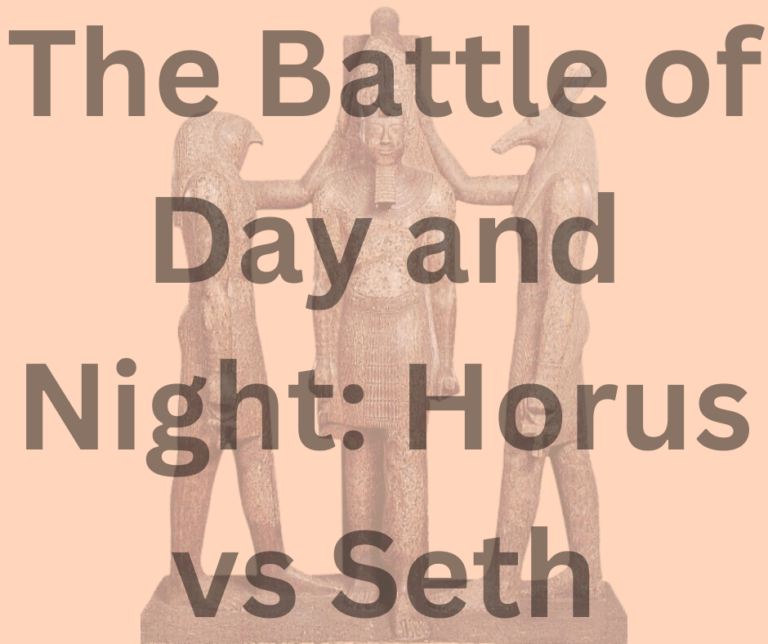
The mythological conflict between Horus, the god of kingship and protection, and Set, the god of chaos and disorder, is one of the central narratives of ancient Egyptian mythology. Their struggle embodies the eternal battle between order and chaos, good and evil. This aspect of their rivalry is often depicted in the symbolism of the Sun and Moon, highlighting the day and night aspects of their battles.
The Divine Conflict
After Seth kills his brother Osiris, Horus begins a rivalry with his uncle, seeking justice for what happened to his father. Seth's fratricidal act and Osiris' usurpation of the throne plunged Egypt into chaos and darkness. Horus, the rightful heir to the throne, is determined to avenge his father's death and regain the kingship.
Read also: The Myth of Osiris: The Tale of Death and Resurrection
The conflict between Horus and Seth takes various forms, often symbolizing the cosmic battle between order and chaos. The gods of the Egyptian pantheon are called upon to mediate and judge the race for the throne of Egypt. Ra lays out a series of challenges to assess the worthiness of both Horus and Seth. These include contests of strength, intelligence and cunning. Thoth, the god of wisdom, plays a crucial role in the proceedings, recording the results of the contests. The goddesses Hathor and Maath also play important roles, representing the concepts of love, balance, and truth.
Sexual Submission
In one version of the myth, Set, the god of chaos and disorder, attempts to assert his dominion over Horus by subjugating him sexually. He believes this will symbolize his supremacy and control over his nephew. The story goes that Seth invited Horus to a feast where he offered him specially prepared food and wine enriched with powerful aphrodisiacs. As the evening progressed, Horus became intoxicated and fell into a deep sleep. Taking advantage of this situation, Seth attempted to have sexual relations with him.
Isis, thanks to her magical abilities, understands Seth's intentions and intervenes. She transforms into a beautiful young woman and approaches Seth seductively. Captivated by the enchanting figure, he engages in sexual intercourse with the "woman". Unknowingly, he has actually performed sexual intercourse with Isis in her transformed state. During the act, Isis removes Seth's seed and places it on a piece of lettuce. When Seth boasted to the gods of his dominion over Horus, they summoned a court to settle the dispute. During the proceedings, the piece of lettuce with the seed is presented, revealing the truth of what happened. This embarrasses and discredits Seth, further illustrating the theme of cunning and deceit in Egyptian mythology.
How Horus lost his eye
Another important episode in the myth involves the loss of Horus' left eye. After the tribunal's decision in Horus' favor, Seth's anger and resentment continue. In a fit of rage and jealousy, Seth attacks Horus and has his left eye removed.
The eye has great symbolism in ancient Egyptian culture. It is associated with protection, healing and restoration. The loss symbolizes the suffering and sacrifices suffered by Horus in his quest for justice and righteous rule.
Revenge of Horus: Severing Seth's Testicles
In retaliation for Seth's attack and the loss of his eye, Horus sought revenge. In some versions of the myth, Horus invites Seth to a contest to determine who is the stronger of the two. Seth, eager to prove his dominance, accepts the challenge.
During the race, Horus cunningly convinces Seth to transform into a hippopotamus, a creature associated with chaos and danger in Egyptian mythology. When Seth assumes this form, he becomes vulnerable. Horus attacks Seth by capturing and castrating him. The act of Horus cutting off Seth's testicles symbolizes the defeat of chaos and the triumph of order and legitimacy. It marked Horus' final victory over Seth and cemented Horus' rule as the rightful king of Egypt.
The victory of Horus
After a long struggle and numerous trials, the gods eventually declared Horus the rightful king of Egypt, vindicating his father Osiris and restoring order to the land. He became the patron of the pharaohs and the embodiment of divine right rule.
Seth, though defeated, continues to be a symbol of chaos and disorder, representing the challenges the pharaohs and the Egyptian people faced to maintain order and balance in their world.
Conflict involving justice, heroism and the struggle for supremacy is a central narrative in Egyptian mythology. Furthermore, it has deep cultural and political significance as it highlights the importance of earthly representatives charged with the task of maintaining order and defending the kingdom from the forces of chaos.
This myth left a deep imprint on Egyptian culture and spirituality, reminding them of the eternal battle between opposing forces and the enduring importance of the belief in Maat, the cosmic balance, in their lives.
The Sun and the Moon
Horus is often associated with the Sun, representing the life-giving, luminous force of the day. His eye, the "Eye of Horus," is a symbol of protection and royal power. He is thought to be the one who dispels darkness, bringing light and order to the world.
Seth, on the other hand, is associated with the moon and the night. The moon, with its changing phases and mysterious glow, is an apt representation of Seth's chaotic and unpredictable nature. He is often depicted as the disorderly force of darkness, evoking the light of the sun.
The night battle
The battle between Horus and Seth extends to the celestial realm, where it plays out as a nightly conflict. In this cosmic drama, Horus, represented by the Sun, will set in the west each night, symbolizing his temporary defeat by Seth, the lord of the night.
Seth, in his role as ruler of the night, seeks to envelop the world in darkness, disrupting the order and harmony established by the sun's rays. Horus, however, rises again from the east, at dawn, dispelling the darkness of night and bringing light and order once more.
The symbolism of day and night
The symbolism of the conflict between Horus and Seth as a battle between day and night had deep meaning for the ancient Egyptians. It reinforced their belief in the cyclical nature of existence, where darkness is followed by light and chaos gives way to order.
This mythical representation finds its place in the Egyptian concept of kingship. Pharaoh, as the earthly manifestation of Horus, is the bearer of light, order, and protection to the land as he attempts to conquer and subdue the chaotic forces that threaten the kingdom, embodied by Seth.
The nightly battle between Horus and Seth, playing out in the heavens, serves as a nightly reminder of the eternal struggle between opposing forces. It reinforces the importance of Maat, cosmic balance, and divine order in both the natural and human realms.
This myth not only enriches Egyptian culture, but presents an eternal narrative that resonates with themes of light and dark, good and evil, and the eternal cycle of life and death.






 English
  Bulgarian