
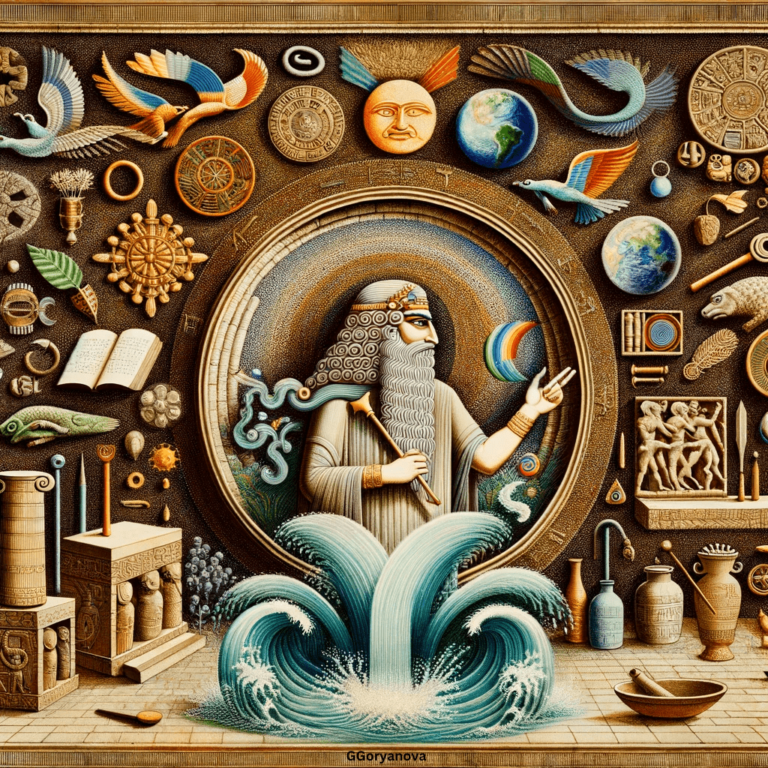
Symbols
The myth of Enlil and Enki is a famous story from Sumerian mythology that dates back to ancient Mesopotamia (around the 3rd millennium BC). Enlil and Enki are two significant deities in Sumerian religion and their myth is filled with esoteric messages, symbols, and conclusions that offer valuable insights into the beliefs and values of Sumerian civilization. Let us analyze some of these elements.
Read also: The Myth of Enki and Enlil
Duality and balance
Enlil and Enki represent two opposing forces in the Sumerian pantheon. Enlil, the god of air and storms, is often associated with power, order, and judgment. Enki, on the other hand, is the god of water, wisdom, and creative energy. This duality reflects the importance of balance in the Sumerian worldview. It suggests that harmony between opposing forces is crucial to maintaining cosmic and earthly order.
Creation and wisdom
Enki's role as the god of wisdom and creative energy points to the Sumerians' reverence for knowledge and innovation. Enki is often portrayed as the source of divine knowledge and the one who holds the secrets of creation. This aspect of the myth underscores the esoteric message that wisdom and creative power are essential to the development of society and civilization.
Water as a symbol
Water is a recurring symbol in the myth associated with the image of Enki. In Sumerian culture, water had great importance as a life-giving force. It symbolizes fertility, abundance and renewal. The myth's focus on Enki's control over Apsu, the primordial freshwater ocean, can be seen as a reflection of the Sumerians' deep respect for the life-sustaining properties of water.
Read also: Symbolism in the Epic of Gilgamesh
Divine intervention
Myth often depicts divine intervention by both Enlil and Enki in the affairs of humanity. Enlil, as master of the earth, is responsible for controlling the destiny of humanity, while Enki intervenes to save humanity from destruction repeatedly. Enlil's role as god of judgment raises questions about divine justice and the consequences of human actions.
Enki's interventions to save humanity from Enlil's wrath present a nuanced view of mercy and the idea that divine beings can intercede on behalf of mortals. This aspect of the myth suggests that Sumerians wrestled with questions of right and wrong and the role of divine guidance in moral dilemmas. This highlights the idea that the gods play an active role in human affairs, demonstrating the Sumerian belief in a cosmic order that humans must respect and conform to.
The interaction of fate and free will
Myth exposes for us the tension between fate and free will. Enlil's decrees often seem like predetermined fate, while Enki's interventions offer a glimpse of human freedom of action and the potential to change fate. This duality reflects the Sumerians' belief in the complex interplay between cosmic determinism and individual choice, demonstrating their contemplation of the limits of human influence in the wider cosmos.
Lessons in leadership
The rivalry and collaboration between Enlil and Enki give us lessons in leadership and management. Enlil's authoritative and sometimes harsh decisions contrast with Enki's more compassionate and innovative approach. This juxtaposition can be interpreted as a commentary on the qualities and responsibilities of rulers, suggesting that a balance between authority and compassion is essential for effective leadership.
Environmental and agricultural importance
The myth also carries agricultural and environmental symbolism. Enlil's control over winds and storms, which could bring either favourable rains or destructive floods, highlights the Sumerians' awareness of the delicate balance between natural forces and human agriculture. This aspect underlines the importance of maintaining ecological harmony and managing natural resources.
The Role of the Divine Sacrifice
In some versions of the myth, Enki sacrifices his own well-being to save mankind from a disaster caused by the gods. This selfless act can be seen as an allegory for the sacrificial rituals that were part of Sumerian religious practices. The idea that a god could willingly suffer for the sake of mortals may have had deep spiritual significance, emphasizing the idea of divine empathy and the reciprocal relationship between gods and humans.
Ancestor worship and cultural identity
The myth of Enlil and Enki also reinforces the concept of the ancestor cult in Sumerian culture. These two deities are considered part of the Anunnaki, a group of divine beings, and their interactions with humanity can be seen as reflecting the Sumerians' belief in the relationship between their ancestors and the gods. This belief in ancestral connections to the divine likely played a significant role in shaping Sumerian cultural identity.
Reflection of the social hierarchy
The myth can also be interpreted as a reflection of the social hierarchy in ancient Sumer. Enlil's authoritative and often uncompromising decisions may symbolize the power and dominance of the ruling elite, while Enki's more compassionate and creative approach may represent the needs and aspirations of the common people. This interpretation highlights the complex interplay between the religious and social dimensions of Sumerian society.
Cosmic order and harmony
The overall narrative of the myth suggests that the Sumerians believed in the existence of a cosmic order and harmony that required the active participation of both Enlil and Enki. Their respective roles as gods of earth and water symbolize the need for cooperation and balance between the elements of the natural world in order to maintain this cosmic harmony. This reflects the people's deep reverence for nature and their understanding of humanity's place within it.
The Forbidden History
The concept of "Enki and Enlil: The Forbidden Story of Humanity's Origin" is often associated with alternative interpretations of Sumerian mythology and theories of ancient astronauts. Although these ideas are not part of mainstream academic understanding, they have gained popularity in certain circles and are often featured in speculative fiction and documentaries.
In this alternate narrative, Enki and Enlil are portrayed as alien beings who have come to Earth from another planet or star system. According to this theory, they were part of an advanced alien civilization that played a key role in creating and manipulating humanity.
The Story
Ancient Astronaut Theory: The alternative interpretation of the roles of Enki and Enlil in the origins of humanity is often associated with the broader ancient astronaut theory. This theory, popularized by writers such as Erich von Deniken, suggests that ancient gods or advanced beings from other planets or dimensions visited Earth in the distant past and influenced human civilization. Enki and Enlil are sometimes portrayed as key figures in this theory, with their actions and interventions seen as evidence of alien involvement in our history. They are said to have arrived on Earth in technologically advanced spacecraft. They are presented as beings with advanced knowledge and technology far beyond that of humans. They taught the Sumerians mathematics, astrology, medicine and construction.
Genetic manipulation
Enki and Enlil are credited with genetically engineering early humans. Enki, in particular, is often portrayed as the scientist who used genetic manipulation to create Homo sapiens by combining the DNA of existing hominids with extraterrestrial DNA, thus accelerating human evolution.
Conflicts between the gods
The alternative narrative often portrays Enlil as a strict and authoritarian figure who wants to control humanity, while Enki is seen as a benevolent figure who seeks to empower and educate people. This leads to conflicts and power struggles between the gods, resulting in various interventions in human affairs.
The Forbidden Knowledge
Enki is considered to be the one who gave forbidden knowledge to mankind, including agriculture, mathematics and science. This knowledge is sometimes described as a gift that helped humans advance, but also led to divine punishment and the downfall of civilizations (similar to the story of the Garden of Eden).
The Great Flood
In this version of the myth, it is Enki who warns a chosen man, often called Zeusudra or Atrachasis, of an impending cataclysm sent by Enlil to destroy humanity. Enki instructs the chosen man to build an ark to save himself and chosen animals.
Enlil and Enki - the Anunnaki from the planet Nibiru
The concept of "Anunnaki" from the planet Nibiru is a popular but speculative idea that has attracted attention in some fringe theories, especially in the realm of ancient astronaut and pseudo-archaeological literature. It proposes a link between the Anunnaki, a supposed alien race, and the ancient Sumerians.
Here is an overview of the concept
Anunnaki
The Anunnaki are believed to be a race of advanced beings originating from a planet called Nibiru. It is often described as the most distant and elongated planet in our solar system, with an eccentric orbit that brings it closer to Earth only once every thousand years. According to Jan Van Helsing and Stefan Erdmann in their book The Millennium Lie (pages 408-419)
Anunnaki in Sumerian mythology
The term "Anunnaki" itself derives from Sumerian texts, where it is used to refer to a group of deities in their pantheon. According to the counter proponents of this theory, these Sumerian Anunnaki were gods with various roles and attributes, not extraterrestrial beings.
The link is
Proponents of the theory argue that the Sumerian Anunnaki were actually alien visitors from Nibiru who played a central role in shaping early human civilization. They are often credited with providing humans with knowledge, technology and even genetic manipulation.
Sumerian tablets
The books of Zekaria Sitchin, a proponent of this theory, popularized the idea of the Anunnaki. In his book, The Twelfth Planet, he argues that ancient Sumerian cuneiform tablets contain hidden messages that reveal the true story of human origins and the Anunnaki influence on Earth.





 English
  Bulgarian