
The Book of the Dead serves as a practical guide to help the deceased navigate the afterlife, avoid pitfalls, and achieve a positive outcome in the judgment of the gods. The book's intricate illustrations and hieroglyphs demonstrate the artistic achievements of ancient Egypt and provide insight into their religious beliefs. The influence of the book extends beyond ancient Egypt, with its themes and ideas resonating in later religious and philosophical thought.
"The Egyptian Book of the Dead, also known as the Book of the Coming Day, is one of the most significant and well-preserved religious texts from ancient Egypt. This ancient manuscript provides valuable information about the ancient Egyptians' beliefs, rituals and worldview regarding death, the afterlife and the journey of the soul. We will explore the origins, content and meaning of this remarkable text.
Historical context
The themes and beliefs in the Book of the Dead have evolved over time in ancient Egyptian culture in several ways:
Early ritual practicesA: The earliest antecedents of the Book of the Dead can be traced to the Pyramid Texts, which were inscribed on the walls of the pyramids of the pharaohs during the Old Kingdom (c. 2686-2181 BC). These texts focus mainly on ensuring the pharaoh's safe passage into the afterlife and emphasize royal rituals and protection against malevolent forces.
Expanding access to the afterlifeA: Over time, beliefs and rituals related to the afterlife expanded beyond the pharaohs to include the nobility and, eventually, the common people. This shift led to the development of texts during the Middle Kingdom (c. 2055-1650 BCE) that were intended for a wider audience.
The New Kingdom (c. 1550-1070 BC) marks the emergence of the Book of the Dead as a comprehensive guide for people to navigate the afterlife. It included a more standardized set of incantations emphasizing ethical behavior, moral responsibility, and the importance of Maat (truth, justice, and order).
Read also Introduction to Ancient Egyptian Religion
The point
The doctrine of the Unseen "world", the relationship between our "world" and the levels of the Beyond, has been formed. If the "Pyramid Texts" of the Old Kingdom solved the problem of the king's post-mortem existence, the question before the subjects was how to follow in the footsteps of their lord and, by serving him, to touch the goods of the Beyond.
Since the king was not a man but a god, he alone possessed the spirit Ba (Bai), which after "death" flew away and mingled with the supreme deity. Until the end of the Old Kingdom, only the kings and other gods had Ba. At the same time the king became Osiris, and his successor Horus. The royal tomb is a testimony to the belief in the need for an incorrupt corpse (the mummy), although a number of data suggest that in the Old Kingdom era the mummy was no longer needed for the afterlife and can be seen simply as a tradition.
Understanding the Book of the Dead requires an awareness of the polytheistic belief system of ancient Egypt, including the pantheon of gods, their roles, and their interaction with humans. It describes the practice of mummification, emphasizing its importance in ancient Egyptian funerary rituals and the preservation of the body for the afterlife.
Contents of the book
The book contains a collection of incantations, hymns and prayers. These incantations are often called "chapters" and serve different purposes. The crucial part of the book, is a ceremony that was meant to restore the deceased's ability to see, hear, speak and eat in the afterlife. For this, the eyes, ears, mouth and nostrils are opened in these ceremonies.
The spells are used to keep the heart and organs working, to protect against suffocation, spells against walking upside down, against eating excrement and a new death. At the same time, again through incantations, the deceased could transform himself "into any god he wished to become," as well as into all sorts of forms.
It contains, also, declarations of innocence where the deceased denies having committed specific sins or moral transgressions. These declarations are intended to clear the way to the afterlife. The book provides detailed instructions on how to navigate the treacherous journey through the Duat, the Egyptian underworld, and how to interact with various deities.
Many versions of the Book of the Dead include elaborate illustrations and hieroglyphs depicting scenes from the afterlife and the journey of the deceased. For it includes descriptions of the rituals and offerings necessary to appease the gods and secure a favorable verdict in the Hall of Ma'at, where one's heart is weighed against the pen of truth - this is the classical concept of eternal life.
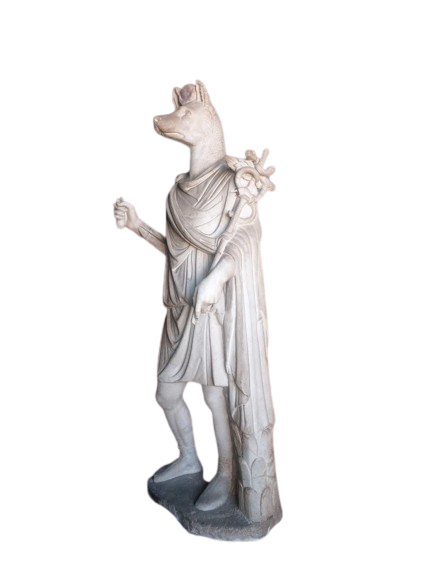
The concept of Maat, representing truth, justice and cosmic order, is a recurring theme throughout the book. The deceased must align with Maat in order to advance in the afterlife. The god Osiris, ruler of the afterlife, plays an important role. Anubis, the god of mummification and protector of the deceased, guides them through the Duat.
At a later stage it is applied, representing the belief of the eternal life of the soul. To live long on earth, one must create only Truth. Make the weeper weep no more, do not drive away a man because of his father's property, do no harm to others, beware of punishing unjustly, do not kill but punish with blows and imprisonment, and through this the earth will be settled. The criminal whose intentions are revealed must be punished. God knows who is the executioner and punishes his sins with blood. One whose merits are known and with whom you have sung the scriptures together shall not be killed. And so, in order to reject the accusations in the Hereafter, one must do good and not sin during earthly life.
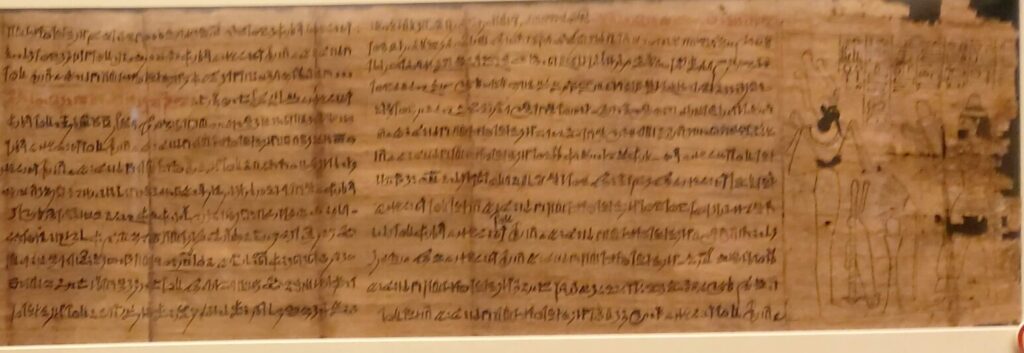
The 'Ptah-Sokar-Oziris' typology represents a mummified funerary deity as a symbol of life after death and is a characteristic element of the funerary rituals of upper-class individuals in the Late Period. The scroll contains 5 pages in hieratic type with chapters from the Book of the Dead.
Personal archive
Read also: Introduction to Ancient Egyptian Religion
Beliefs and concepts
Central to the book is the belief in an afterlife where the soul, called "ka", reunites with the body (ba) and continues its existence.
The Egyptians imagine the soul as an extremely thin double, which reproduces the personality of a person in the smallest details, his stature, color, movements, gait. Whenever one of us appears in the world, his double, or as the natives call him, his Ka, comes with it. Besides being a doppelganger, ka is interpreted as "life force", "genius protector", "individuality", "personality". It was believed that the double accompanies man in all the vicissitudes of his earthly existence, follows him to the tomb and, more importantly, it is the double (the soul) that lives on in the afterlife after the death of the mortal body. The dead body and the image of Ka possess a sense of smell. Hence the immense significance of incense burning and pre-smoking for the cult.
In the ancient Egyptian tomb, the room with the statue of the deceased is called the "Court of the Double". It is clear from the inscriptions that the Egyptians regarded the image as a "door" from which the person depicted emerged, i.e. The Double is that, the living, which is in the image and which comes out of it. The texts unequivocally emphasize that artists are creators of the Afterworld, i.e., the world of the dead. The afterlife is reduced to the life of the reality associated with the images, i.e. it turns out that the invisible world consists of many small, "private" worlds, each of which is as individual and concrete as any tomb with its images can be. This "world of images" exists against the background of the transcendent "world of the corpse," which, by virtue of its supernatural nature, cannot be depicted but is described by the funerary texts.
After all, life after leaving the body was seen as a parallel existence of different levels of the "imperishable corpse," the Name and the Double, which were connected by an invisible thread. A range of evidence suggests that this whole complex was driven and governed by the Name. It is evident that, even without Ba, the mere mortal Egyptian imagined life after death as an existence with more possibilities, mainly due to the fact that the human personality was simultaneously present on several planes, freed from the shackles of the body.
In the texts, the Otherworld is the "west", the "immenti", in Egyptian it is the necropolis, the West as the direction of the world, and the complex notion of the afterlife. In the opposite direction is the East, the land of the god, somewhere out there beyond the confines of the Eastern Desert, the place from whence the Sun appears. In the Old Kingdom era, the notion of life in the Afterlife was reduced to Ka's life in the tomb. The First Transitional Period and the Middle Kingdom now parallel the realm of the dead, where the god of the dead, Osiris, rules. Finally, in the New Kingdom one can speak of a world (cosmos) of the dead.
Reflection
The Book of the Dead invites people to reflect on deep questions about the nature of the soul, the consequences of human actions, and the pursuit of a just and meaningful existence. Through it, we not only gain a deeper understanding of the past, but a broader perspective on the enduring human search for meaning, spirituality, and exploration of the mysteries of existence. The book's legacy serves as a testament to the enduring power of ancient wisdom and human fascination with the afterlife.




 English
  Bulgarian