Origin
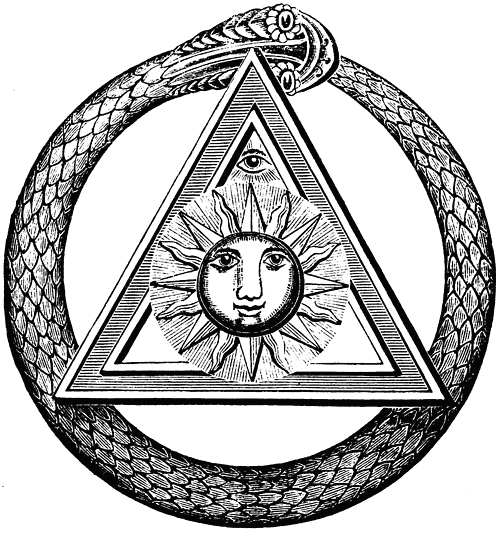
The first records of the uroborus symbol were found among the Egyptians, the Chinese and the people of Northern Europe (associated with the folkloric snake Jormungand) more than 3000 years ago. In Egyptian civilization, it was a representation of the resurrection of the Egyptian deity Ra in the form of the Sun. It is also found among the Phoenicians and Greeks.
The Snake
The serpent, which in canonical texts is associated with evil aspects, as in the book of Genesis 3:13, (The Lord God asked the woman, What is this that you have done? The woman replied, The serpent deceived me, and I ate it). In most pre-Christian cultures, is a symbol of wisdom. Assuming that the Uroboros is a pre-Christian symbol, it can be assumed that this concept of wisdom is prevalent.
Ingest
The infinite serpent stands as an emblematic representation of eternal repetition, symbolizing the eternal cycle of births and rebirths, the rhythmic flow of the seasons and the oscillation between day and night - a visual capsule of all phenomena converging towards infinity.
It can also be interpreted that the act of absorption is a break in the human cycle in an evolutionary search for spirit on other levels. On the other hand, it can mean self-destruction through the act of consuming one's own flesh and even self-fertilization. Furthermore, the fact that it is in a circular form is an archetype representing continuous movements and may also represent the universe. In addition to the interpretation that the serpent operates in the lower realms (Hell) while the circle represents the Divine realm. In other situations the animal has two different colors. In this case, probably a reference to yin and yang, or male and female poles, day and night, good and evil and other paradoxes of nature.
Alchemy
Within the transformative process of transmutation Materia Prima undergoes a division of its elementary principles. This division is vividly portrayed in the alchemical representation of Uroboros, often depicted as two serpents, each devouring the tail of the other. The upper serpent, adorned with wings, crown, and legs, symbolizes Materia Prima in its impermanent state. In contrast, the lower serpent signifies the fixed remnant. It is in the union of these separate elements that the alchemist achieves the desired philosopher's stone, called the "Great Elixir" or "Quintessence." This symbolic convergence encapsulates the culmination of the alchemical journey, a harmonious synthesis that bestows transformative power upon the seeker. It contains the ideas of movement, continuity, self-fertilization and therefore, eternal return.







 English
  Bulgarian