
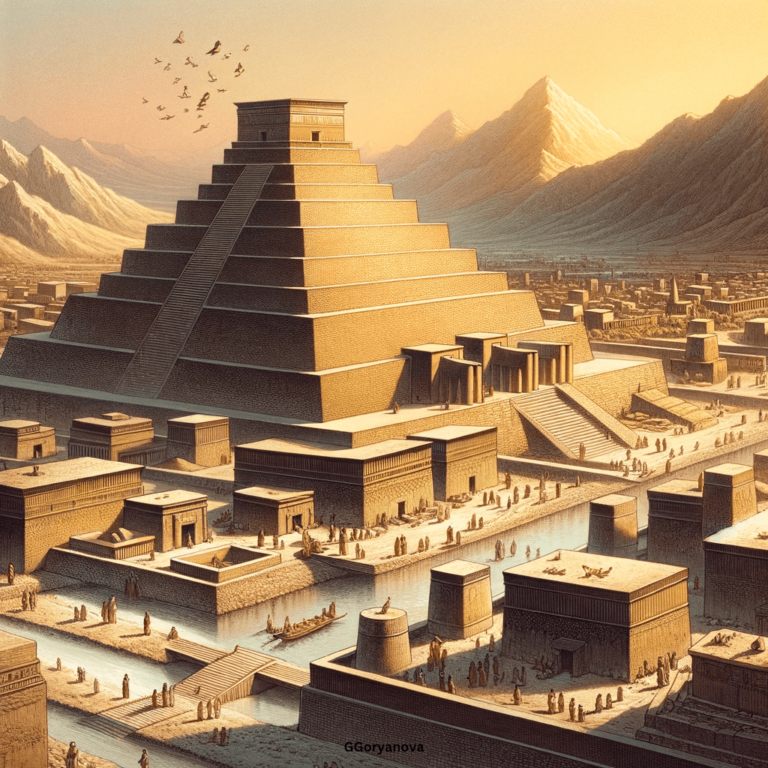
The emergence of Sumerian civilization marks a pivotal moment in human history, representing one of the earliest known complex societies to emerge in the ancient world. The Sumerians, who inhabited southern Mesopotamia (present-day southern Iraq) between the Tigris and Euphrates rivers, left an indelible mark on the course of human civilization. In this article we will touch on the following topics in general:
- Development of Sumerian society
- The base 60 numerical system in science and medicine
- The birth of the writing system
- The Ur-Namu Code
Development of Sumerian society
Sumerian civilization began to take shape around 4000 BC when several city-states, including Ur, Uruk, Eridu, and Lagash, began to rise in the fertile plains of Mesopotamia. Each of these city-states developed its own government, administration and culture, marking the beginning of the emergence of a distinctive Sumerian identity.
Architectural influence
Architecture and urban planning, especially the construction of ziggurats, influenced the architectural styles of neighboring civilizations. The ziggurat design, characterized by a stepped, pyramid-like structure, is reproduced in temples and monuments throughout the region.
Trade and cultural exchanges
The Sumerians were active traders involved in trade with neighboring regions such as the Indus Valley and Anatolia. This trade facilitated the exchange of goods, ideas, and cultural influences, enriching Sumerian society.
One of the main mechanisms of cultural diffusion is trade. Cities were centres of trade, facilitating the exchange of commodities such as grain, textiles and metals with neighbouring regions. Through trade, they interacted with people from different cultures, introducing their own customs, technologies and ideas while adopting those of their trading partners.
Agricultural Revolution
The emergence of Sumerian civilization is closely linked to the agricultural revolution. The Sumerians were among the first to practice systematic agriculture, using irrigation systems to harness the waters of the Tigris and Euphrates rivers. This allowed them to grow crops such as barley and wheat, developing a growing population and urbanization.
Social organization
Society is hierarchically structured. At the top are the rulers, often called "lughals" or kings, who rule the city-states. Below them are the priests, administrators and scribes responsible for managing the affairs of the city. The majority of the population consisted of farmers, laborers, and artisans.
Legal systems
Their legal principles, exemplified in the Ur-Namu Code and the earlier Urukagina Code, influenced the development of legal codes in neighbouring regions. These legal traditions, including concepts of justice and governance, were adopted and adapted by later civilizations in Mesopotamia.
Religion and mythology
The Sumerians have a rich pantheon of gods and goddesses whose religion is deeply intertwined with everyday life. Temples, called ziggurats, were built to honor deities, and religious rituals played a central role in society. The Sumerian creation myth, Enuma Elish, and the Epic of Gilgamesh are among their famous literary works that explore religious and mythological themes.
Their religious beliefs and practices had a wide spread because of interaction with neighboring peoples such as the Akkadians and later with the Babylonians and Assyrians. They integrated elements of foreign religions into their own pantheon.
Technological progress
This culture provided significant technological impetus, such as the development of the wheel, which revolutionized transportation and commerce. They also created sophisticated irrigation systems enabling large-scale agriculture, building impressive architectural marvels such as ziggurats and city walls.
Read also: Ancient Egyptian polytheism - the dawn of faith
The base 60 numerical system in science and medicine
As one of the world's earliest civilizations, they left a remarkable mathematical and scientific legacy that continues to influence modern mathematics and science. One of their most enduring contributions is the base-60 numeral system, which serves as the basis for various mathematical concepts and measurements.
Numerical system base 60
The Sumerians are credited with developing one of the earliest known numerical systems based on the number 60. In this system, numbers are represented using a combination of two symbols: a symbol for "1" and a symbol for "10". For example, to represent the number 23, they used two symbols: one for 20 (represented as a horizontal wedge) and one for 3 (represented as three vertical wedges). The system is very flexible and allows relatively easy representation of large numbers. It facilitates arithmetic operations, making calculations more efficient than previous systems. The concept of 60 minutes per hour and 360 degrees in a circle, which is still used today, has its roots in the Sumerian base 60 system. The influence of this system can be seen in timekeeping, geometry and trigonometry.
Mathematics and Astronomy
The Sumerians made significant advances in mathematics, including arithmetic, geometry, and algebra. They developed methods for solving equations, calculating areas of shapes, and understanding concepts of proportion.
The Base 60 system has been used for a wide range of mathematical calculations: from recording financial transactions, to measuring land and construction projects. This practical application of mathematics laid the foundation for more advanced concepts in later civilizations.
As keen astronomers, the Sumerians observed and recorded the movements of celestial bodies. They created one of the earliest star catalogues, which included information on the positions and movements of the stars and planets. Thanks to base-60, make accurate astronomical calculations. This helps them predict celestial events and develop a calendar with lunar and solar components.
Because of their meticulousness in measurements, they have established standardized units for length, weight, and volume. These are based on their numerical system and form the basis for trade and construction.
The elbow (about 50 cm) is a standard unit of length, influencing the construction of buildings, temples and infrastructure in Mesopotamia and neighbouring regions.
Medicine
Приносът на шумерската цивилизация в областта на медицината е, като документират различни заболявания и лечения. Те записват медицинските си познания върху глинени плочки, давайки ни ценна представа за здравните практики на времето.
Thanks to their mathematical knowledge and celestial observations, they understand lunar and solar cycles, which has implications for medical and agricultural practices.
Why exactly the number 60? It divides into 1, 2, 3, 4, 5, 6, 10, 12, 15, 20 and 30 equal parts. Due to this way they developed different concepts. For example, in mathematics, they divided the circle into 360 parts. After solar observations, they calculated that a day consists of 24 hours, 1 hour is equal to 60 minutes, developed the clock system with numbers from 1 to 12. They also created a calendar made up of 360 days in a year, with the number 60 entered exactly 6 times.
Раждането на писмената система в шумерската цивилизация
The birth of the writing system known as cuneiform stands as a remarkable achievement in the annals of human history. It marks one of the earliest instances of humans moving from oral traditions to a systematic method of recording information and transmitting ideas. The development of cuneiform occurred around 3500 BC and played a central role in the evolution of written language.
На шумерската цивилизация се приписва развитието на една от най-ранните системи за писане в света, известна като клинопис. Тази писменост, характеризираща се с клиновидни знаци върху глинени плочки, първоначално е била използвана за водене на записи и счетоводство. Появата на писмения език играе решаваща роля в администрацията на градовете-държави, записването на законите и запазването на знанията.
Най-ранните форми на писменост в шумерската цивилизация са били пиктографски по природа. Шумерите започват със създаването на прости, визуални представяния на обекти или концепции. Тези ранни символи са изображения, които предават значение.
Over time, the Sumerians began to move beyond simple pictograms to develop more complex pictorial representations. These symbols evolved into ideograms, where a symbol represents not only a physical object, but also abstract concepts, actions, or ideas. For example, a drawing of a foot might denote the concept of "walking" rather than just a literal foot.
As Sumerian society became more complex, the need for a more efficient and flexible writing system grew. This led to the transition from purely pictorial representations to more abstract writing. Symbols gradually became less recognizable as representations of physical objects and more as stylized, cuneiform signs.
The cuneiform has further evolved to represent not only whole words, but also individual syllables and sounds. Sumerian scribes developed a system whereby each cuneiform character could represent a particular sound or syllable. This innovation allowed for a more flexible and expressive writing system that could be used for a variety of languages and purposes.
Typically, this script was written on clay tablets using a stylus, creating wedge-shaped impressions. These tablets were widely used for record keeping, bookkeeping, legal documents, literature, etc. Sumerian scribes, who underwent extensive training, played a crucial role in the dissemination of knowledge and the preservation of records.
The Sumerian writing system did not remain limited to Sumer. As trade and cultural exchange expanded, cuneiform spread to neighboring regions, including Akkad, Babylon, and Assyria. In these regions, cuneiform was adapted and evolved to suit the needs of their respective languages.
The Code of Ur-Namu - ancient legal and ethical concepts
Ur-Namu, one of the earliest known legal codes in human history. Created around 2100-2050 BC in the city-state of Ur during the Third Dynasty of Ur, it predates the Code of Hammurabi. The Ur-Namu reflects the legal and moral principles that governed society in ancient Sumer, providing us with information about the values, ethics, and governance of the time of this ancient society.
The Sumerians, living in the fertile lands of Mesopotamia (modern-day Iraq), are among the earliest known civilizations in the world. Their society was organized around city-states, each with its own ruler and legal system. The codex was discovered on a clay tablet in the ancient city of Nippur, demonstrating the widespread influence of this legal code.
It consists of numerous laws and decrees, revealing a complex legal framework governing various aspects of Sumerian life. Several key legal and ethical concepts derive from this ancient code:
- Equality and fairness: the principles of equity and fairness are fundamental. It states that the law should apply equally to all citizens, regardless of their social status. This commitment to equality reflects the Sumerians' belief in a just society where even rulers and nobles are subject to the law.
- Retribution and restitution: the Code prescribes specific penalties for various offences, ranging from fines to physical punishments such as flogging. These punishments are designed not only to deter wrongdoing but also to provide restitution to victims. The ethical principle of compensating victims of misconduct underscores the importance of accountability.
- Family and inheritance: family matters such as marriage, divorce and inheritance are governed by the Code. These laws reflect the ethical importance placed on maintaining family structures and ensuring the proper transfer of property and rights to heirs.
- Gender and Slavery: Although the code reflects the patriarchal nature of Sumerian society, it also sets certain ethical standards regarding the treatment of women and slaves. It includes provisions protecting women's rights, such as prohibiting forced marriages and requiring husbands to care for their wives in the event of divorce.
The Code of Ur-Namu, though relatively short, laid the foundation for subsequent legal developments in Mesopotamia and beyond. Its ethical principles of justice, equality, and property rights influenced later legal systems in the region. Notably, many aspects of it find their place in the Code of Hammurabi, a more comprehensive legal code that is known for its role in shaping the legal and ethical principles of Babylonian society.
The Code of Ur-Namu offers insight into the legal and ethical concepts of ancient Sumer. It reflects a society that valued justice, equality, and property rights, while addressing family, gender, and slavery issues. These ancient rules laid the foundation for subsequent legal systems and played a crucial role in shaping the ethical principles that underpinned ancient Mesopotamian civilization. The enduring legacy of the Code of Ur-Namu reminds us of the timeless importance of just governance in human societies.


 English
  Bulgarian