

In the ancient Egyptian mythological story known as "The Parting of Nuth and Geb", the sky goddess Nuth and the earth god Geb are the main characters. This story symbolizes the deep reverence that the ancient Egyptians had for the celestial and terrestrial forces that governed their lives, as well as the eternal struggle between order and chaos.
The Divine Union
In the past, when the world was a chaotic, undifferentiated mass, the gods and goddesses were bound by the infinite embrace of Nuth, the goddess of the vast, starry sky, and Geb, the god of the prologue Earth. Nuth and Geb are brother and sister who fall deeply in love. Their intertwined bodies create a powerful and harmonious balance between the celestial and terrestrial spheres.
The Appeal of Ra
The divine union between Nuth and Geb, however, attracts the attention of Ra, the sun god and ruler of the cosmos. He fears that their relationship poses a threat to the cosmic order. In his view, the two cannot remain so connected, as it hinders the potential for creation and growth. He believes that their children will usurp his power, leading to chaos and disorder in the world.
Fearing this prophecy, Ra decrees that Nut must remain forever separated from Geb, forbidding her to give birth any day of the year. Nuth, however, had already conceived, and these divine offspring were trapped between her and Earth. Her pain and despair were immeasurable as she longed to give birth to her children. To free them, she had to find a way to distance herself from Geb's grasp.
The intervention of Thoth
With the help of Thoth, the god of wisdom and knowledge, Nuth devised a plan. She challenged Honsu, the moon god, to a game of senet, an ancient Egyptian board game. The stakes were high. Nuth staked her moonlight, and Honsu, who was in love with her, accepted the challenge.
The game unfolded as Nutt won round after round. As she piled up victories, she demanded more and more valuable rewards. Finally, she requested five extra days beyond the usual month and added them to the calendar.
Honsu, consumed by his desire for Nutt, agreed, unaware of the consequences. The extra days gave Nuth the time she needed to distance herself from Geb, allowing her to become the curved, star-studded sky we know today.
The birth of the children of Nut
During these five added days, known as the "five epagomenal days," Nut gave birth to five mighty deities: Osiris, Isis, Set, Nephthys, and Horus. Each played a significant role in Egyptian mythology and culture.
Osiris becomes the god of the afterlife, symbolizing resurrection and renewal.
Isis is revered as the goddess of magic, motherhood and healing.
Seth embodies chaos and disorder.
Nephthys is a patron goddess associated with death and funerary rituals.
Choir represents heaven and is a symbol of the kingdom and divine power of the pharaoh.
Read also: Introduction to Ancient Egyptian Religion
The importance of myth
In ancient Egyptian beliefs, Nut and Geb were integral to the cyclical nature of life and death. This myth illustrates the interconnectedness of the celestial and terrestrial spheres, encapsulating the eternal rhythms of creation, preservation, and transformation.
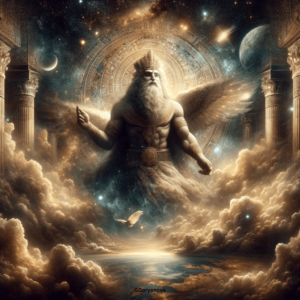
Nuth's body arches over the sky, creating the heavenly canopy. As the day dawns, she gives birth to the sun god, Ra, who embarks on his daily journey through her body. At night, Ra is swallowed by Nut, passing through her celestial belly to be reborn at dawn.
Geb, the god of the Earth, represents the realm of the living and the resting place of the deceased. When people die, it is believed that their souls descend into Geb's arms where they will find rest and nourishment.
This cosmic cycle symbolizes the eternal nature of existence. The rising and setting of the sun, the changing of the seasons and the changing of the generations are reflections of the eternal dance of Nut and Geb, demonstrating that life and death are part of a larger, harmonious order.
The deep understanding of the universe influenced the spirituality of the Egyptians and their profound reverence for heavenly and earthly forces. It guided their beliefs about the afterlife, the cycles of nature, and the cosmic forces that shaped their world.
The parting of Nuth and Geb serves as a symbolic representation of the ancient Egyptians' understanding of the cosmos and their deep reverence for heavenly and earthly forces. It conveys several basic meanings:
Cosmic Order
The myth stresses the importance of maintaining cosmic order and balance. The separation of Nut and Geb is necessary to maintain the divine harmony of the universe.
Eternal struggle
The eternal struggle between cosmic and earthly forces, and between order and chaos, is a recurring theme in Egyptian mythology. This myth illustrates this ongoing battle.
Resilience and determination
Nuth's determination to bear her children against all odds symbolizes the resilience and determination of the Egyptian people in spite of the odds.
Importance of knowledge
Thoth's intervention highlights the importance of wisdom and knowledge in overcoming challenges and finding solutions.
The myth reflects the Egyptians' deep respect for the forces that shaped their world, their commitment to maintaining cosmic order, and their enduring belief in the power of wisdom and determination to overcome obstacles.





 English
  Bulgarian