

Mankind has long sought to understand the nature of reality using both metaphysical knowledge and scientific research. Kabbalah, quantum physics, and sacred geometry share remarkable parallels. Although they derive from different methodologies, these fields are interwoven with an interconnected energy.
Kabbalistic concepts
Kabbalah describes reality as emanating from Ein Sof (Infinity) through a series of ten sefirot, which represent dynamic channels through which divine energy flows in the material world. These sefirot illustrate the interplay of forces that create balance in the cosmos. Central to Kabbalah is the idea of unity, which underlies the apparent plurality, a concept reflected in other fields of study.
Read also: Basic concepts in Kabbalah - keter (crown)
Ein Sof and the principle of unity
Ein Sof is the infinite source of all existence in Kabbalistic thought. It is beyond comprehension, devoid of attributes, and serves as the ultimate source of reality. Ein Sof embodies the absolute unity from which all diversity is derived.
Read also: Kabbalah and the Journey to the Divine
Unity in multiplicity Despite the appearance of a fragmented universe, Kabbalah teaches that all phenomena originate from Ein Sof. This unity reflects the scientific idea of a unified field in quantum theory, where all forces and particles originate from a single fundamental reality.
Transcendence and immanence: Ein Sof transcends physical and metaphysical dimensions, but is immanent in all creation, reflecting the paradoxical nature of infinity.
Sephiroth as channels of divine energy
The Sefirot are the ten dynamic emanations through which Ein Sof manifests in the cosmos. They represent the structure of creation and the flow of divine energy, both in the universe and in the human soul.
Read also: Basic concepts in Kabbalah - Hokhmah (Wisdom)
Energy flow and balanceA: The Sephiroth interact in a precise and harmonious system where each channel balances and complements the others. This interaction reflects the principles of energy dynamics, such as conservation and resonance.
Hierarchical and fractal nature: Each sephira contains aspects of the others, forming a fractal-like network. This structure is consistent with the self-similarity observed in natural systems and fractal geometries.
Non-locality in Kabbalistic thought
Non-locality in Kabbalah refers to the interconnectedness of all events and entities beyond physical proximity. The actions of a plane are thought to ripple through the spiritual and material worlds, similar to quantum entanglement.
Spiritual entanglement: Just as entangled particles affect each other instantaneously over vast distances, Kabbalah holds that human actions can have immediate, far-reaching spiritual consequences.
Beyond space and time: Nonlocality challenges the conventional limitations of time and space, positing a reality in which cause and effect operate at a higher, unified level.
Conceptual Intersections with Science
Ein Sof and unified theories
In physics, the search for a unified field theory seeks to describe all forces and particles as manifestations of a single fundamental reality. Ein Sof provides a metaphysical parallel to this scientific quest, framing existence as a single, infinite source from which the manifold arises.
Sephiroth and energy dynamics
The system of sephiroth emanations resonates with scientific patterns of energy flow and balance. In quantum physics, energy exists in discrete packets (quanta), like the individual yet interconnected sefirot. In addition, the fractal organization of sefirot reflects natural patterns found in physics and geometry.
Nonlocality and quantum entanglement
Quantum entanglement shows that particles can be instantaneously connected regardless of spatial separation. This is a phenomenon that reflects Kabbalistic notions of spiritual interconnectedness. The idea that events are connected across vast distances is consistent with the Kabbalah view of a unified, nonlinear reality.
Implications for understanding reality
Unity at the heart of diversity: Ein Sof suggests that the apparent differences and dualities in the universe are expressions of a single, infinite source. This perspective promotes a holistic view of existence.
Dynamic balance of power: Sephiroth emphasize the importance of balance and harmony in the flow of energy, a principle applicable in both spiritual and scientific frameworks.
Interconnectedness: The principle of non-locality links spiritual teachings and quantum mechanics, showing us the deep connections that transcend conventional boundaries.
Principles of quantum physics
Quantum physics describes the behavior of energy and matter at the subatomic level. It challenges classical notions of determinism and locality, revealing a universe in which particles are interconnected through entanglement and influenced by observation.
Wave-particle duality
Wave-particle duality reveals that photons and electrons exhibit both wave and particle properties, depending on the context of observation.
Dual behaviour: When unobserved, particles behave like waves propagating through space. When observed, they act as individual particles. This duality evokes binary frames, emphasizing the fluidity of matter and energy.
Interaction of opposites: The dual nature of particles resonates with metaphysical ideas, such as the Kabbalistic teachings of opposites coexisting harmoniously in creation.
Quantum entanglement
Quantum entanglement occurs when two particles become entangled, so that the state of one particle instantaneously affects the other, regardless of the distance between them.
Non-localityA: This phenomenon implies that spatial separation is illusory at the quantum level, since the particles remain part of an indivisible whole.
Cosmic interconnectedness: Entanglement reflects metaphysical concepts of unity, where actions in one realm echo into another.
Observer effect
The observer effect demonstrates that the act of measurement collapses the probabilistic state of a quantum system into a particular outcome.
Conscious participation: Observation actively shapes the behavior of quantum particles, blurring the line between observer and observed.
Reality as interactive: This principle implies a participatory role in the creation of reality, in accordance with philosophical notions of consciousness as the co-creator of the universe.
Implications of quantum concepts
Wave-particle duality and the nature of reality
The wave-particle duality highlights the dynamic nature of existence. The dual behaviour of particles implies that reality cannot be understood through categorical definitions, but requires a holistic perspective.
In philosophical terms, this equates to systems that integrate opposites to achieve unity. For example, the sefirot of Kabbalah represent opposing attributes (e.g., mercy and judgment) harmonized within a unified system.
Quantum entanglement and unity beyond space-time
This phenomenon challenges the classical notions of locality and causality because the relationship between particles operates outside the constraints of space and time. Albert Einstein called it "ghost action at a distance", expressing his concern about its implications for deterministic physics. The implications are as follows:
Non-local connectionsA: In classical physics, interactions take place through forces that move through space over time. Entanglement contradicts this by showing instantaneous effects, suggesting that entangled particles share a deeper, non-local connection. Phenomena that were once thought to be separate are revealed as part of a unified whole.
Cosmic implications: Entangled systems behave as a whole, regardless of spatial separation. This unity implies that space and time are emergent phenomena rather than fundamental properties of reality. Entanglement opens up possibilities for understanding the universe as a single, integrated system, echoing metaphysical traditions that emphasize unity across physical boundaries.
The bystander effect and the role of consciousness
The observer effect emphasizes consciousness as a fundamental aspect of reality. By influencing quantum systems, observation becomes an active participant in the creation of events.
Holographic implications: The interconnectedness seen in entanglement is consistent with holographic theories, which hold that information about the entire universe is encoded in each part. This idea resonates with metaphysical notions of a unified reality in which all parts reflect the whole.
Metaphysical resonanceA: Philosophical and spiritual traditions have long held that human consciousness plays a fundamental role in shaping reality. This notion, often described as metaphysical resonance, suggests that consciousness not only perceives the world but also actively influences its structure and behaviour. Recent developments in quantum physics provide compelling links supporting the idea that reality is shaped by the observer's interaction with it.
Parallels with metaphysical perspectives
Duality:Quantum mechanics and metaphysical traditions share remarkable conceptual parallels. The wave-particle duality resonates with systems that reconcile opposites, such as the yin-yang in Taoism or the interplay of divine attributes in Kabbalah.
Shaping Reality: Kabbalah emphasizes the role of human intention to align with divine energy, which shapes reality through spiritual action.
Hermeticism: The hermetic principle "As above, so below" emphasizes the interrelationship between mind and cosmos.
Sacred geometry
Sacred Geometry explores the mathematical principles underlying the natural patterns, symbolic forms and structures of the universe. These geometric patterns are seen as manifestations of universal order and precision, connecting material and metaphysical realms. Sacred geometry emphasizes that form and function are not separate but unified aspects of existence. Its visual and mathematical representations bridge abstract concepts and tangible experiences, reflecting the unification of waves and particles in quantum physics.
Key concepts and their quantum parallels
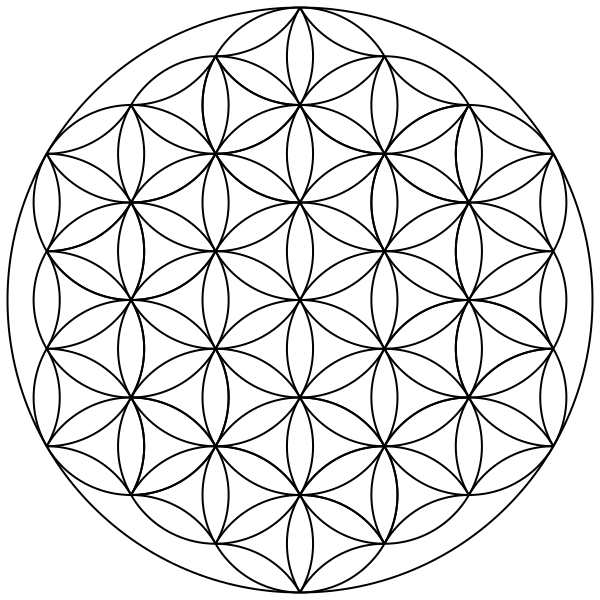
The flower of life - withthe symbol of interconnectedness and creation.
It is a geometric pattern composed of overlapping circles forming a lattice of interconnected spheres. It is often considered a symbol of creation, representing the unity and interconnectedness of all life.
InterconnectivityA: In quantum physics, particles and systems are fundamentally connected by phenomena such as quantum entanglement. Similarly, the light of life illustrates a web of connections where each part contributes to the whole.
Universal Plan: The model is considered a visual representation of the structural framework of the universe, resonating with the idea that quantum fields are the underlying fabric of reality.
Creation and emergence: Just as the Flower of Life expands outward in its geometry, quantum phenomena give rise to a complexity of simple interactions, highlighting emergent properties.
Platonic solids - geometric shapes and structural organization
Platonic solids are highly symmetrical, three-dimensional forms that are related to the classical elements earth, water, air, fire, and ether. These solids-the tetrahedron, cube, octahedron, dodecahedron, and icosahedron-represent the basic building blocks of reality.
Energy structures: In quantum physics, the organization of particles, waveforms, and energy fields often adheres to symmetric and stable structures analogous to Platonic solids.
Atomic and molecular geometryA: The spatial arrangement of atoms in molecules and crystals exhibits a symmetry reminiscent of Platonic solids, reflecting the configuration in nature - efficient, stable configurations.
Structural analogies with Sephiroth: Just as Plato's bodies symbolize the elemental forces, the Sefirot in Kabbalah represent the channels of energy that form the structure of creation. Both systems emphasize harmony and balance.

Fractals: self-replicating patterns and infinite complexity
Fractals are geometric shapes that exhibit self-similarity, meaning they look similar at any scale. These patterns, like the Mandelbrot Set, demonstrate how complexity arises from simple rules applied iteratively.
Infinite complexityA: Fractals embody the idea of infinite detail in finite limits, much like quantum systems where infinite possibilities arise from finite initial conditions.
Scale invariance: Just as fractals preserve their structure at different scales, quantum phenomena, like wave functions, act consistently at different levels of observation.
Dynamic systems: Fractals are dynamical systems in equilibrium, like quantum systems, that maintain coherence through superposition and entanglement.

Interconnections between geometry and quantum physics
The parallels between quantum physics and geometric concepts glimpse reality differently:
InterconnectivityA: Both fields emphasize that all phenomena are interrelated, forming a unified whole.
Structural harmony: The symmetric organization observed in Platonic bodies and quantum systems reflects the inherent balance and coherence of nature.
Infinite potential: Fractals and quantum mechanics reveal that infinite complexity and possibility can arise from simple origins.
These findings encourage research and interdisciplinary approaches integrating: physics, geometry and metaphysics to deepen our understanding of the cosmos.
Visualising quantum principles
Geometry provides a tangible framework for representing abstract quantum principles. The interlocking circles of the flower of life, for example, can symbolize the entanglement of particles, while Platonic solids visually encode the stable symmetries of atomic and molecular arrangements.
Unity and diversity
All three geometric systems emphasize how unity is the basis of multiplicity. The singular pattern of the Flower of Life gives rise to infinite possibilities, Platonic solids represent universal archetypes, and fractals demonstrate unity in multiplicity through self-similar forms. These principles are consistent with a quantum understanding of the universe as a unified field expressing diverse phenomena.
Creation and emergence
In quantum physics, emergent properties arise from the interaction of fundamental particles and fields. Similarly, geometric models such as fractals and the flower of life demonstrate how simple rules or designs can lead to complex structures.
Convergence
The intersections between these three disciplines are striking.
Unity and emanation
All three systems assume that the set arises from a single source. In Kabbalah, Ein Sof gives rise to creation through the Sefirot. Quantum physics postulates that the universe arises from a quantum field, while sacred geometry visualizes this unity through archetypal forms.
The shared emphasis on emanation underscores a common understanding of the layered and hierarchical nature of reality. Each system views origins as infinite and indivisible, yet capable of manifesting infinite diversity.
Energy interaction
Both cabalistic and quantum frameworks describe a dynamic flow of energy. Kabbalistic teachings about Sephiroth interactions parallel quantum principles such as wave interference and resonance that govern energetic behavior in the physical world. Sacred geometry illustrates these interactions through harmonic proportions and spatial relationships. For example, the relationships between Sephiroth resemble fractal patterns in sacred geometry, where similar structures recur at different scales. In quantum physics, this is reflected by the fractal organization of quantum fields.
Non-locality
Kabbalistic doctrines of spiritual influence are consistent with the quantum entanglement demonstration that events can correlate instantaneously over vast distances. Spatial representations of sacred geometry similarly transcend conventional notions of locality, emphasizing the interconnectedness of all forms. Nonlocality in these systems points to a deeper reality where spatial and temporal divisions are illusory. This insight forms the basis for understanding the deep interconnectedness of all phenomena.
Implications for understanding reality
The parallels between these fields suggest that the division between spiritual, scientific and symbolic systems is artificial. Inferences from Kabbalah, quantum physics, and sacred geometry converge to present a holistic understanding of reality that values interconnectedness and multidimensionality. These perspectives challenge materialist assumptions, inviting exploration of the metaphysical foundations of existence.
This synthesis highlights the need for interdisciplinary approaches in addressing deep questions about the universe. By integrating these frameworks, humanity can strive for a more complete and unified perspective on existence.



 English
  Bulgarian