
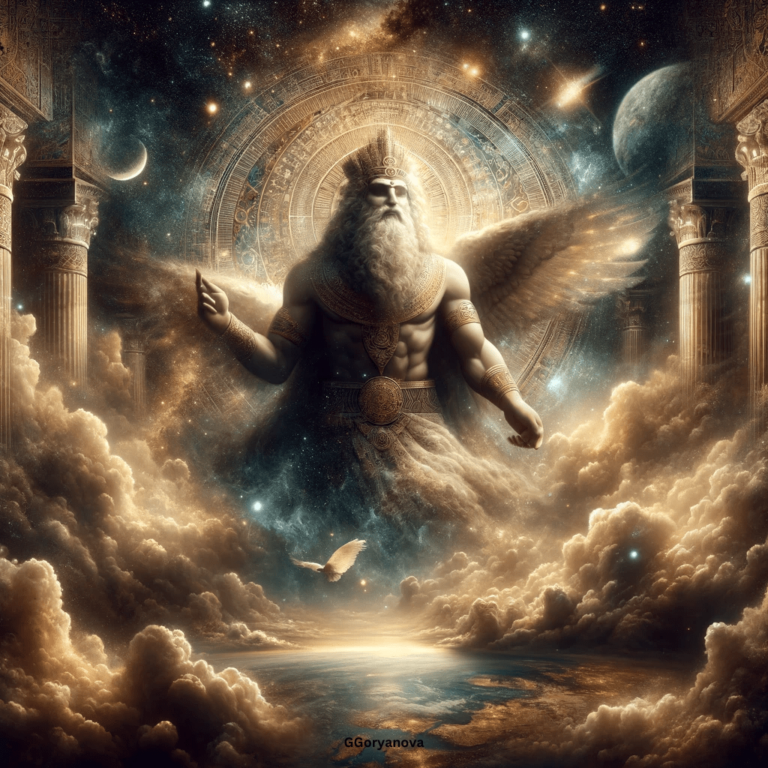
The ancient Sumerian civilization, flourishing in southern Mesopotamia (present-day Iraq), is one of the earliest known civilizations in human history. Dating back to the 4th millennium BC, the Sumerians are known for their contributions to language, architecture, and their complex pantheon of gods. Sumerian religion was polytheistic, with multiple gods, each associated with natural elements and aspects of life. The main gods in ancient Sumer were:
Anu (An) - the God of the heavens, the supreme deity in the Sumerian pantheon
Anu, often considered the supreme deity in the ancient Sumerian pantheon, occupies a significant place in Mesopotamian mythology. His name, which means "sky" in Sumerian, is a clear indicator of his dominion and power. Anu is the god of the heavens, the outermost layer of the universe, and personifies the infinite expanse of the sky.
Importance
As a god of the heavens, he was believed to dwell in the highest realms of heaven, far above the earthly world and other deities. He is often associated with the symbol of a hat with horns representing divinity and stars or the celestial sphere. Anu is at the top of the Sumerian divine hierarchy. His position as father of the gods, especially key deities such as Enlil and Enki, emphasizes his paramount status.
Mythology and cult
In Sumerian mythology, Anu is often involved in creation stories. He is sometimes depicted as the primordial being from whom the universe and the other gods originated. He is often referred to as the father of multiple gods, thus establishing a divine lineage that reinforces the structured nature of the Sumerian pantheon. His direct worship is less prominent than other gods such as Enlil or Inanna. This may be due to its abstract and distant nature. Temples dedicated to Anu are rare, but one notable temple is the Temple of Eana in Uruk.
Influence and legacy
Anu is closely associated with the constellations and heavenly bodies, which are considered to be physical manifestations of the gods. His relationship with the stars reinforces the idea of his omnipresence. The concept of a supreme celestial deity is a common motif in many ancient religions, and Anu's role in Sumerian mythology likely influenced later cultures in the region, including the Akkadian, Babylonian, and Assyrian pantheons. In modern interpretations of ancient Mesopotamian religions, the god is often seen as a symbol of the transcendent, unfathomable aspect of the divine, representing a form of spirituality that is beyond the earthly realm.
Enlil - The god of air and storms, Enlil is a major deity who plays a key role in creation myths

Enlil, a paramount deity in the ancient Sumerian pantheon, stands as one of the most important gods in Mesopotamian mythology. Known as the god of air, breath, wind and storms, Enlil holds a position of immense power and influence, second only to Anu, the god of the sky.
Nature
Enlil's dominion over air and wind connects him intrinsically to the vital aspects of life and the natural world. He is responsible for the breath of life and can bring both beneficial winds and destructive storms. He is represented by symbols of power such as the shepherd's staff and the crown with horns, signifying his status as a leader among the gods. His main centre of worship is the Ekur temple in Nippur, considered the "mooring rope" of heaven and earth. This temple was one of the most sacred places in ancient Sumer.
Role in mythology
In Sumerian mythology, Enlil plays a key role in the creation of the world and humanity. He was instrumental in dividing heaven and earth and organizing the universe. He also has the power to decree destinies. His decisions are considered final and binding on both gods and humans. He appears in numerous myths and epic tales, including the famous Epic of Gilgamesh. His actions and decisions often have significant consequences for gods and mortals alike.
Cultural significance
He was often seen as the embodiment of kingship and power. Ancient Sumerian kings often claimed to have been chosen by Enlil to legitimize their rule. His role also extended to maintaining order and balance in the world. He was a figure of moral and ethical authority, enforcing divine laws and ensuring harmony. Although primarily a god of air and wind, Enlil also plays a role in agriculture, using his control over the winds to aid in the growth of crops.
Influence and legacy
Enlil is a central figure in many Sumerian texts, highlighting his role in the religious and mythological consciousness of the Sumerians. The worship of Enlil continued into the Akkadian, Babylonian, and Assyrian periods, as his attributes and stories were appropriated and adapted to their cultures.
In modern times, the character of Enlil has been the subject of much scholarly research, providing insights into the values, beliefs, and social structures of ancient Mesopotamia.
Enki (Ea)- God of water, knowledge, crafts and creation. Enki is known for his wisdom
Enki, also known by his Akkadian name Ea, was a prominent deity in ancient Sumerian mythology, worshipped as the god of water, wisdom, magic and creation. His domain extends to the subterranean freshwater ocean known as the abzu or apsu, making him also a god of the underworld.
Attributes and iconography
Enki is primarily associated with water, an important element in Mesopotamian life due to the region's dependence on irrigation for agriculture.
Symbolism
He is often depicted with flowing water that includes a fish, symbolizing his dominion over water and life. Art and sculptures often depict Enki with a beard signifying wisdom and wearing a hat with horns as a sign of his divinity. Enki's temple, E-Abzu, was located in the city of Eridu, believed to be the first city in Sumerian mythology.
Role in myths and legends
Enki is known as a benefactor and protector of humanity. He is often credited with creating mankind and protecting it from the wrath of the other gods. He gave various crafts and knowledge to mankind, playing a key role in the cultural and technological advancement in Sumerian civilization. The myths of Enki are filled with stories of his wisdom, cunning and ingenuity. He often outwitted other gods or solved creative problems, reflecting his intelligence and ingenuity.
Cultural and religious significance
Enki was widely revered throughout Sumer and later in Akkad, Babylon and Assyria. His cult was especially large in his city, Eridu, but extended beyond. As a water deity, Enki was crucial to fertility and agriculture. He was believed to supply the fresh water needed for irrigation and agriculture, making him a vital god to the Sumerian economy.Enki was also seen as a god of wisdom and ethics. He was often invoked in matters of justice, morality and guidance.
Influence and legacy
Enki figures prominently in various Sumerian literary texts, including: the Epic of Gilgamesh, Enki and the World Order, and Enki and Ninhursag. These stories not only highlight his role, but also offer insights into Sumerian culture and values. In astrology, he is associated with the planet Mercury, which is seen as the embodiment of his attributes.
The figure of Enki has been the subject of scholarly research in the context of ancient Near Eastern religions. His character as a wise and benevolent god has made him an object of interest in the study of mythology and ancient religions.
Inanna (Ishtar)- Goddess of love, beauty, sex, desire, fertility, war, justice and political power
 Inanna, known in Akkadian as Ishtar, is one of the most prominent and complex deities in ancient Mesopotamian mythology. Worshipped as the goddess of love, beauty, sex, desire, fertility, war, justice, and political power, Inanna embodies a set of attributes that are both contrasting and complementary.
Nature and attributes
Inanna is unique in her embodiment of both nurturing and destructive aspects. She is the goddess of love and fertility, associated with romantic and erotic love, as well as a fierce warrior goddess known for her anger and ability to cause chaos and destruction.
Symbolism
It is often depicted with symbols of fertility and strength, such as a lion and an eight-pointed star. Her representation ranges from gentle and loving, to fierce and powerful, reflecting her dual nature. Inanna is one of the most widely revered deities in the ancient Mesopotamian pantheon, her influence spanning several millennia and cultures.
Role in myths and legends
One of her most famous myths is her descent into the underworld. In this story, she attempts to expand her power by taking over the underworld ruled by her sister Ereshkigal, but instead, is stripped of her powers and possessions and dies. She is eventually resurrected, symbolizing the seasonal cycle of fertility and vegetation.
The concept of sacred marriage, or hieros gamos, between Inanna and her husband Dumuzi was a central theme in Sumerian rituals and festivals, symbolizing the union of the divine feminine and masculine, as well as fertility and prosperity on earth.
Inanna appears in The Epic of Gilgamesh, where she proposes marriage to the hero Gilgamesh, who rejects her, leading to a series of events that affect the outcome of the story.
Worship and temples
Her main cult centres are the Eanna temple in Uruk and the Zabalam temple, where she is much revered. The worship of Inanna involves various rituals and ceremonies, including sacred prostitution. This term originated from the performance of sexual practices in sacred temples. These were part of her fertility cult.
Influence and legacy
The images and attributes of Inanna/Ishtar influenced later deities in the Greco-Roman pantheon, such as Aphrodite and Venus. In modern interpretations, Inanna has become a symbol of powerful femininity, embodying attributes traditionally ascribed to both sexes. Her figure continues to be an object of interest in the study of ancient Near Eastern religions, gender studies, and comparative mythology.
Read also: Cities in ancient Sumer
Utu (Shamash) - the Sun God, responsible for justice, morality and truth
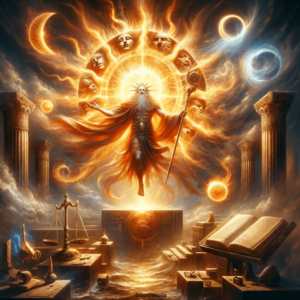
Utu, known to the Akkadians as Shamash, is a significant deity in ancient Mesopotamian mythology. He is worshipped as the god of the sun, justice, morality and truth. As a solar deity, Utu's daily journey across the sky is seen as a symbol of the triumph of order over chaos and light over darkness.
Nature and attributes
As the sun god, Utu represents the life-giving energy and light that is essential to all life on earth. His journey from east to west in his solar chariot marks the passage of time and the cyclical nature of life.
Utu is also the god of justice and law. He is used in legal matters and is believed to help in establishing fair and just rulings. His light is seen metaphorically as illuminating truth and dispelling injustice.
Utu is often depicted as rising from the mountain at dawn holding a saw-like knife, symbolizing his role in cutting through deceit and injustice.
Role in myths and legends
In mythology, Utu is represented as an arbitrator who helps those in need of justice. He helps in righting wrongs and is often approached for judgment.
Utu plays a role in the Epic of Gilgamesh, helping the hero in his missions. His relationship with Gilgamesh highlights his role in guiding and helping those who walk the righteous path.
Utu often interacts with other gods in the pantheon, playing a role in various divine narratives and maintaining the balance of the cosmic order.
Worship and temples
One of its main centers of worship is the temple of E-Babar in Sipar, although it was revered throughout Mesopotamia.
The daily rituals in its temples reflect its journey across the sky, with ceremonies at dawn and sunset. The priests of Utu were influential in the community, often playing roles in legal matters.
Influence and legacy
The representation of Utu/Shamash as a fair and just deity had a significant influence on Mesopotamian law and kingship. Many kings would portray themselves as chosen or guided by Utu/Shamash to emphasize their commitment to justice.
In astrology, Utu/Shamash is associated with the Sun and thus plays a vital role in divination and omens. Its imagery and symbolism are evident in Mesopotamian art and literature and it is present in many hymns, prayers and legal texts.
Nanna (Son) - the Moon God, Nanna is the symbol of wisdom, father of Inanna and Utu

Nanna, worshipped in ancient Mesopotamian religion, is the Sumerian moon god. He is also known by his Akkadian name Sin and is one of the key deities in the Mesopotamian pantheon. As a lunar deity, Napna had significant importance in the mythology and religious practices of ancient Sumer.
Nature and attributes
Nanna represents the moon and its cycles, which were crucial in the Mesopotamian calendar for marking time and regulating festivals.
Symbolism
He is often depicted riding a winged bull or boat, symbolizing his journey through the night sky. The crescent moon is his most recognizable symbol, often appearing in art and iconography.
As a moon god, Nanna is associated with wisdom, fertility and the passage of time. The waxing and waning of the moon symbolizes the cycle of life and death, growth and decay.
Role in mythology
Nanna was the son of Enlil and Ninlil, two major deities, and was the father of other important gods, including Utu (the sun god) and Inanna (the goddess of love and war).
Although Nanna may not feature as prominently in the myths as some other deities, he has a constant presence in the pantheon, often giving advice and support to other gods and goddesses.
Worship and temples
Its main cult centres are in the cities of Ur and Haran. The great ziggurat of Ur, dedicated to Nanna, is one of the most famous and well-preserved temple complexes in Mesopotamia.
The worship of this god involves monthly festivals coinciding with the phases of the moon. His priests and priestesses played a significant role in the rituals and were highly respected in Sumerian society.
Influence and legacy
As a moon god, he is an integral part of the Mesopotamian understanding of astronomy and astrology. The lunar calendar, influenced by Nanna's cycles, is essential to agricultural and religious activities. The god's constant presence in the night sky makes him a symbol of constancy and reliability in a world where many other aspects of life are unpredictable.
Ereshkigal - Goddess of the underworld, she is the sister of Inanna and an important deity in the Sumerian pantheon

Ereshkigal, a prominent figure in ancient Mesopotamian mythology, is the goddess of the underworld and ruler of the dead. Her domain is Irkala, the Mesopotamian underworld, where she presides over the final destination of souls after death. Ereshkigal's role in the pantheon is crucial, as she represents the dark double of the celestial deities.
Nature and attributes
Ereshkigal is the queen of the underworld, a place where the dead live. Unlike many mythologies where the underworld is a place of punishment, the Mesopotamian underworld is more neutral, a place where all souls go regardless of their deeds in life.
She is often portrayed as a fearsome goddess, commanding respect and even fear from other gods. In art, she can be shown as a figure carrying a throne, symbolizing her sovereignty over the dead.
She is the older sister of Inanna (the goddess of love and war). This relationship represents a balance between life and death, love and war, growth and decay.
Role in myths and legends
One of the most famous myths involving Ereshkigal is the Descent of Inanna. In this story, Inanna descends into the underworld to attend the funeral of Ereshkigal's husband, Gugalanna. She, feeling threatened, imposes various trials on Inanna, which ultimately lead to Inanna's death and subsequent resurrection. This myth is symbolic of the cycle of the seasons and the agricultural cycle.
Ereshkigal is often seen as a judge of the dead, deciding their fate in the afterlife. Though a fearsome figure, she is also seen as just and necessary to the balance of the cosmic order.
Worship and temples
Unlike other Mesopotamian deities, she did not have a widespread public cult. Her worship was more secretive and limited, often intertwined with funerary practices. The priests and priestesses who served her often engaged in funerary rituals, ensuring the proper journey of the dead to the underworld.
Influence and legacy
Ereshkigal's role in Mesopotamian mythology highlights the ancient Mesopotamians' views of death and the afterlife, which were not necessarily feared but were accepted as a natural part of life. As ruler of the underworld, it symbolized the inevitable power of death and the need for balance between the forces of the upper and lower worlds. In modern studies of ancient mythology, Ereshkigal is often seen as representing the darker aspects of the divine feminine, providing a counterpoint to the life-giving figures of the mother goddess.
Ningursag (Ninmah) - the goddess of the earth and the mother associated with fertility and nature
Ninhursag, also known as Ninmah or Nintu, was a revered goddess in ancient Mesopotamian mythology. She holds an important position as the goddess of the earth, fertility and childbirth. Ninhursag is often depicted as the mother goddess, embodying the nurturing aspects of nature and the earth.
Nature
Ninmah represents the fertile land and is often associated with the creation and development of life. She is often depicted with symbols of fertility and abundance, such as plants and animals, emphasizing her role as the nurturer and caretaker of all living things.
It has numerous and different titles reflecting its various roles and functions. As Ninmah, she is the "Great Queen", and as Nintu, she is the "Lady of Birth".
Role in myths and legends
This goddess is often implicated in creation myths where she aids or enables the creation of life, both human and divine. She plays a crucial role in shaping humanity and the natural world. In many myths she is described as the mother of gods and humans, often depicted as a divine midwife or mother figure. One of her most famous myths is the tale of Enki and Ninhursag, which illustrates the interconnectedness of fertility, water and the earth. The story also highlights her role in healing and restoring balance.
Worship and temples
As a major deity it was worshipped in various cities in Sumer and Akkad. However, specific temples dedicated solely to her are less documented compared to other major deities. Her worship probably included rituals for fertility, childbirth, and the protection of crops and livestock, reflecting her role as nurturer and giver of life.
Influence and legacy
Her role as earth goddess and mother makes her an integral part of Mesopotamian religion, symbolizing the life-giving and sustaining forces of nature. She is often seen as a symbol of maternal care and protection, overseeing the natural processes of birth and growth. Ninhursag represents an archetype found in many mythologies around the world, the figure of Mother Earth, who is central to creation and life myths.
Ningal - Wife of the moon god Nana, mother of Inana and Utu
Ningal is a goddess in ancient Mesopotamian mythology, worshipped primarily in Sumerian and Akkadian cultures. She is known as the goddess of the reeds and the consort of Nanna (Sin), the moon god. Ningal holds a significant place in the pantheon, especially through her connections with other major deities.
Nature and attributes
Ningal's association with reeds equates it with the natural world, particularly the swamps that were abundant in ancient Mesopotamia. These areas are vital for their ecological richness, mineral wealth and resources.
As Nanna's wife, is closely associated with lunar qualities. Her role complements that of the god, linking her to aspects of the moon such as cycles, fertility and weather.
The goddess is known for being the mother of several important gods, including Inana (Ishtar), the goddess of love and war, and Utu (Shamash), the sun god. This maternal role reinforces her importance in the divine lineage.
Role in myths and legends
She often appears in mythological narratives in a supporting role, primarily as the wife of Nanna and mother of Inanna and Utu. Thanks to her offspring, she symbolizes fertility, motherhood, and the nurturing aspect of divine femininity.
Worship and temples
Ningal was worshipped in the city of Ur, one of the main centers of moon worship in ancient Mesopotamia. Temples and ziggurats dedicated to Nanna also served as places of worship to her.
While the specific rituals and festivals are less documented, it was an integral part of the worship practices associated with the moon god and their divine progeny.
Influence and legacy
As a goddess who combines the roles of wife, mother, and nature deity, she represents the multifaceted aspects of womanhood in the context of ancient Near Eastern mythology.
In modern studies of ancient religions, Ningal is often the subject of study in the context of family dynamics among deities. In this way, we gain insights into how ancient cultures perceived divine relationships and gender roles.
Ningirsu - God of war and agriculture, important in the city of Lagash
Ningirsu, an ancient Mesopotamian deity, occupies a significant position in the Sumerian pantheon. He is primarily associated with the city-state of Lagash, where he was worshipped as a patron god. He embodies the characteristics of both a god of war and an agricultural deity, reflecting the dual needs of protection and sustenance in ancient Mesopotamian societies.
Nature and attributes
His dual aspects as god of war and agriculture highlight his role in both protecting the city and ensuring its prosperity through fertile lands and good harvests.
It is often depicted with symbols of strength and fertility, such as a mace or thunderbolt, and sometimes with agricultural tools, indicating its connection to agriculture.
It is also associated with an eagle with the head of a lion, a mythological creature known as Imdugood or Anzu. This creature symbolizes strength and power and is often found in the iconography associated with Ningirsu.
Role in myths and legends
Ningirsu plays a crucial role as Lagash's point guard. He was called upon to win battles and to protect the city from external threats.
In addition to its martial aspects, it is revered for providing fertility. He was believed to bring rain and abundant harvests necessary for the city's sustenance.
Although the specific myths focused solely on Ningirsu are less well known than other major Sumerian deities, his presence in the pantheon is essential to understanding the religious and cultural practices of ancient Lagash.
Worship and temples
The main centre of worship is in Lagash, especially at the temple known as E-Ninnu, which is dedicated to him. The pilgrimage includes rituals and ceremonies that celebrate its dual aspects. Festivals are likely to include both martial events and agricultural rituals in honour of his diverse powers.
Influence and legacy
As the god of war, he was considered the protector of justice and order, often mentioned in legal inscriptions and documents. His dual role as a warrior and agricultural deity made him a symbol of the balance between strength and sustenance, reflecting the needs and values of ancient Mesopotamian society.
Heritage
The Sumerians left an indelible mark on human history. Their cuneiform writing is one of the earliest forms of writing, and their epic narratives, such as the Epic of Gilgamesh, continue to fascinate. Their innovations in agriculture, architecture (such as the development of the ziggurat), and the creation of city-states laid the foundation for future civilizations in the region and beyond. Understanding Sumerian civilization offers insight into the origins of urban society and the complexity of human religious and cultural development.






 English
  Bulgarian