
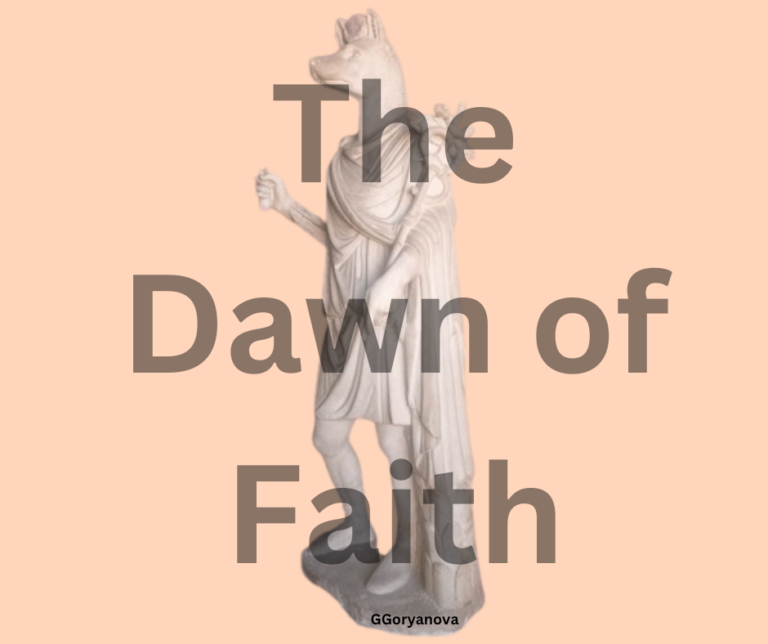
In the shadow of the Sphinx, where the sands whisper secrets of ages long gone, the ancient Egyptians found solace in the arms of their gods. The dawn of their belief system heralded an era in which divine beings walked among mortals, shaping destinies with well-intentioned or not-so-intentioned actions.
Polytheism is not just a religious doctrine - it is a living, breathing force that permeates every aspect of Egyptian life. From the farmer tending his fields to the pharaoh holding his scepter, all are connected by the invisible threads of the pantheon.
The sun, moon and stars were not just heavenly bodies-they were objects of divine presence. Ra, the sun god, commanded the heavens, bestowing life-giving rays on the fertile earth. When the first light of day kissed the sacred temples, people bowed in reverence, acknowledging the eternal dance between the mortal and the divine.
Read also: Introduction to Ancient Egyptian Religion
The Nile, a lifeline running through the heart of the desert, is more than a river. It is accepted as the earthly manifestation of Hapi, the god of fertility. Each flood contributes not only silt to rejuvenate the soil, but also a divine promise of abundance. People dependent on the river's grace offer prayers and tributes, ensuring the gods' continued favor.
As we embark on this odyssey through the annals of time, let the echoes of eternity reverberate in your soul. The beliefs of the ancient Egyptians were not confined to the temples; they were engraved on stones testifying to the rise and fall of dynasties.
Gods and Goddesses: Divine Ensemble
In the celestial theater of ancient Egypt, gods and goddesses graced the stage, each playing a unique role in the cosmic drama. As we go deeper into the pantheon, we encounter a diverse ensemble, each deity evoking awe and reverence.
The divine hierarchy was both complex and interconnected. Osiristhe god of the afterlife, stood as a beacon of hope for the departed, promising eternal existence beyond the mortal world. His double, Isis, embodies the nurturing essence of motherhood and possesses great magical powers.
Choir, the falcon-headed god, symbolizes the kingdom and the cyclical nature of life. Anubis, with the head of a jackal, guides souls through the perilous journey of the afterlife, ensuring safe passage to the realm of Osiris.
Maat, the goddess of truth and justice, cast her watchful gaze over the earth, ensuring harmony and balance. People, realizing the importance of living according to the principles of Maat, strive to maintain order in their daily lives.
That, the scribe of the gods with the head of an ibis, describes divine actions. He gave the people the hieroglyphics. He wrote the Book of Thoth, the Iumruden Tablets, the Corpus Hermeticum and the Cabalion. He is considered the author of the Book of the Dead. He participated in the "Judgment of the Dead", recording the verdicts of the deceased.
Details about the Book of the Dead and the rituals, in the following articles.
Bastet, the cat goddess, protected homes and brought joy, her benevolence extending to both humans and their animal companions.
Ra: The Radiant Reign of the Sun God
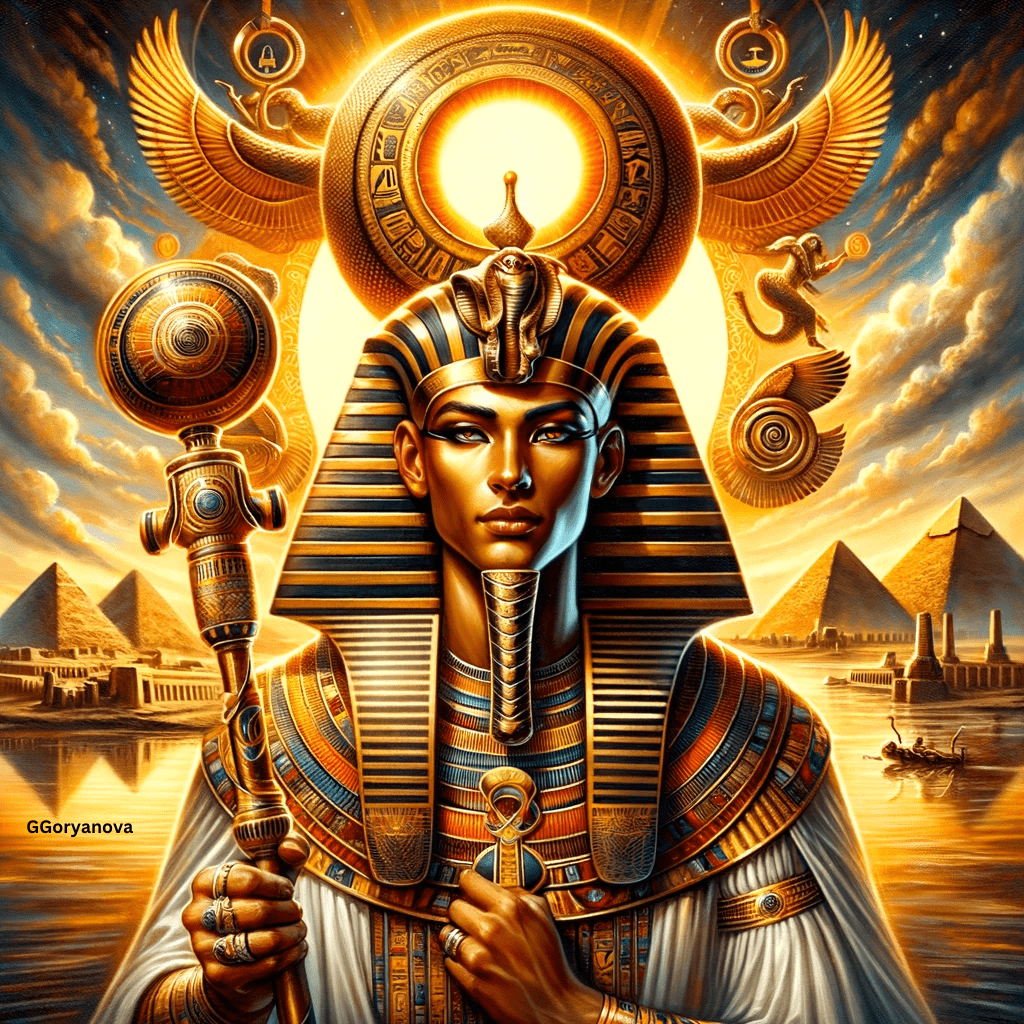
As the cosmic drama unfolds, we turn our gaze to Ra, the radiant sun god who commands the heavens and illuminates the Egyptian landscape with a life-giving radiance. At the heart of polytheistic reverence, Ra stands as a celestial monarch, a deity whose presence transcends the world of mortals.
Ra's journey across the sky marks the passing of time, bringing light to chase away the darkness. The daily passage of the sun, from the eastern horizon to the western depths, reflects the cyclical nature of life, death and rebirth. The Egyptians saw Ra as a symbol of eternal renewal, a divine force that sustained the world.
Yet Ra's journey is not without its challenges. The perilous night journey through the underworld, guided by the benevolent god Thoth, is a struggle against chaos and the forces that seek to extinguish the divine light. This cosmic battle echoes the struggles of mortal life, where they face trials and tribulations on their own journeys.
In temples dedicated to Ra, priests conducted elaborate rituals in honor of the Sun God. The Great Sphinx itself, a colossal monument with the body of a lion and the head of a pharaoh, is considered the guardian of solar energy, symbolizing the eternal connection between the divine and the earthly.
The role of Ra
Ra is often depicted as a falcon-headed deity with a solar disc surrounded by a serpent on his head, a symbol of his solar power. His primary role is that of the sun god and as such he is the one who brings light to the world each day. His journey across the sky from dawn to dusk is seen as a daily renewal of creation, dispelling darkness and chaos.
God the Creator
In some Egyptian creation myths, Ra is believed to be the creator of the world. He is said to have emerged from the primordial waters of Nun, the chaotic and formless void, and created himself. From his tears he created the first humans. He also created other deities, such as Shu (the god of air) and Tefnut (the goddess of moisture), who played an essential role in the formation of the cosmos.
The Solar Bark
One of the most iconic aspects of Ra's mythology is his daily journey in a solar barque, a boat-like craft, across the sky. This journey symbolizes the cycle of day and night and the eternal renewal of life. At night he travels through the dangerous underworld, facing challenges and overcoming obstacles before emerging victorious at dawn.
The Sun Cult
The worship of Ra was central to ancient Egyptian religious practices. It is associated with the pharaohs, who are believed to be descendants of Ra and rule with his divine authority. Temples dedicated to Ra, such as the famous temple at Karnak, were built throughout Egypt and his worship played a vital role in Egyptian society.
The fusion of deities
His significance extends beyond his role as sun god. He became closely associated with other deities over time. This led to the creation of composite deities such as Amun-Ra and Ra-Horakhti, further emphasizing his importance in the Egyptian pantheon.
Shu: The God of Air and Atmosphere
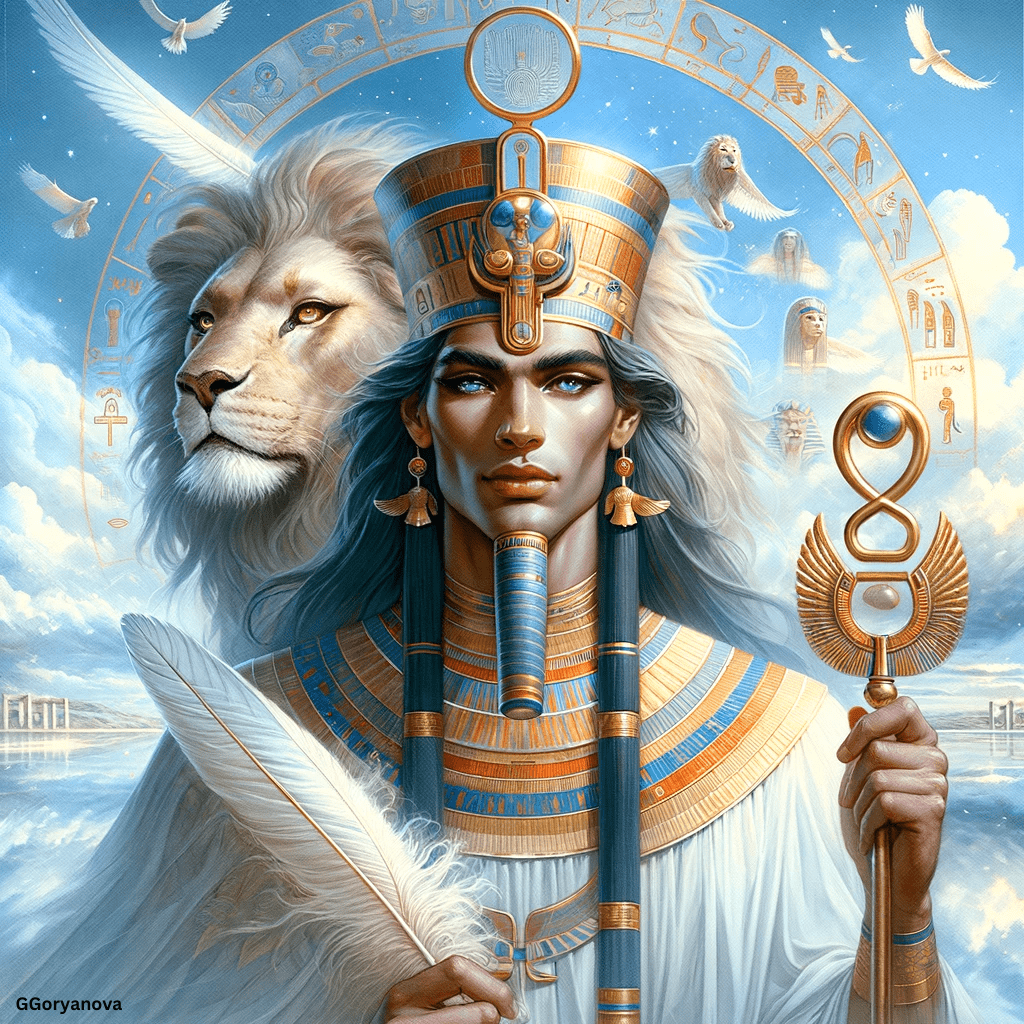
In the complex pantheon of ancient Egyptian deities, Shu stands as a deity of fundamental importance, embodying the very breath of life. As the god of air and atmosphere, he plays a crucial role in creating and sustaining the world, shaping the very essence of existence.
The primary element
He is often depicted as a man holding high the sky goddess Nut, creating a clear separation between heaven and earth. This depiction is symbolic of his primary role - to maintain the vital separation between the Earth (Geb) and the heavens (But), allowing life to flourish.
The name "Shu" means "emptiness," signifying the space he created between heaven and earth. This space allows the circulation of air, a vital element for all living things. It is the embodiment of this life-giving air, symbolizing the breath that sustains all life.
Role in creation
According to Egyptian mythology, the appearance of Shu is an integral part of the creation of the cosmos. In the Heliopolitan creation myth, Atum, the primordial deity, emerges from the waters of chaos and creates Shu and Tefnut, the goddess of moisture and dew, through a process of self-creation. Shu represents the first breath of life and the separation of the elements, while Tefnut symbolizes the moisture necessary for existence.
The separation of Nut (heaven) from Geb (earth), from Shu is seen as the moment of creation itself. This act allows the emergence of earth and heaven, making life possible. God's role in this cosmic drama is to bring order and structure to the primordial chaos.
The Defender and the Balancer
Shu also serves as the protector of the solar boat of Ra, the sun god, during his night journey through the underworld. His presence ensures that the boat will not be swallowed by the chaos of the abyss, preserving the cycle of day and night. In Egyptian cosmology, his role extends to maintaining the cosmic balance. It represents the principles of order, stability and harmony, aligning with the concept of Maat, the divine balance that governed the universe. Shu's presence in the world ensured that chaos and disorder would not overwhelm creation.
The Legacy
The symbolism and significance of the Shu extend to various aspects of Egyptian culture and spirituality. It has been invoked in prayers and rituals, especially those associated with the preservation of the natural order and breath of life. His representation in temple iconography emphasizes his role as a separator and protector. His legacy reminds us of the deep connection between the elements of nature and the spiritual beliefs of the ancient Egyptians. He embodies the breath of life, the very essence that sustains existence. His presence in the cosmos ensures the preservation of order and balance.
Tefnut: Goddess of moisture and dew
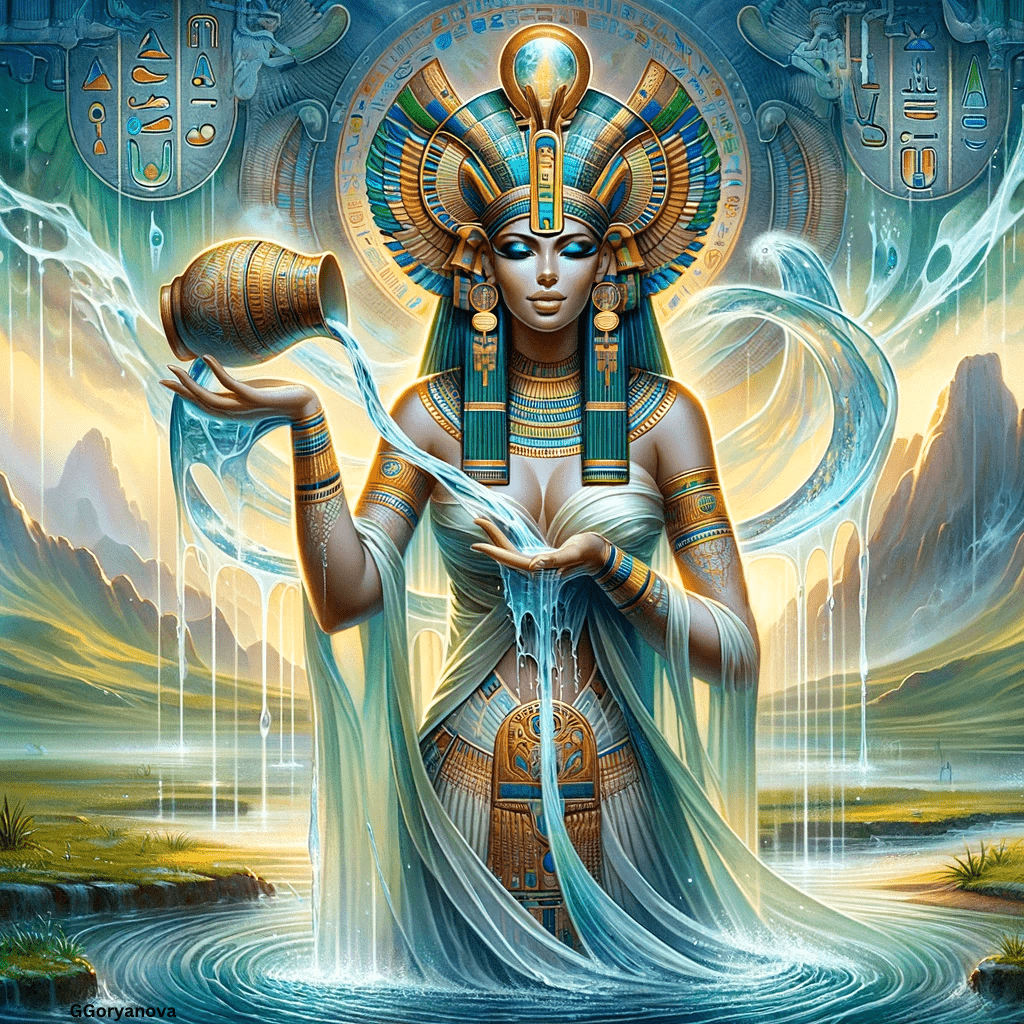
In the pantheon of ancient Egyptian deities, Tefnut occupies a unique and significant role as the goddess of moisture and dew. Her presence is crucial to the balance and vitality of the natural world, as she symbolizes the life-giving qualities of moisture and the rejuvenating power of dew.
The Divine Essence of Moisture
Tefnut is often depicted as a goddess with the head of a lioness, a powerful and regal form that represents her connection to the life-sustaining properties of moisture. Her name "Tefnut" is derived from the Egyptian word "tft", meaning "moist" or "liquid". She is the embodiment of these vital elements.
Moisture in the form of dew is thought to be the nourishing essence that rejuvenates the parched earth, allowing plants to flourish as well as life to thrive in the arid Egyptian landscape. Tefnut is the embodiment of this precious resource and its presence is essential for the fertility, growth and sustenance of all living things.
The birth of Tefnut
According to Egyptian mythology, she was one of the first deities to emerge from the primordial waters of Nun, the chaotic and formless void that existed before creation. She, along with her twin brother Shu, was created by Atum, the primordial deity, through a process of self-creation. The goddess represents the moisture that emerges from Atum's self-creation, while Shu embodies the air.
Their birth marks the beginning of creation itself, as moisture and air are essential elements for the formation of the physical world. Tefnut's presence brings the promise of fertility and a sign of life flourishing.
The Cosmic Balance
Tefnut's role in Egyptian cosmology extends to the concept of Maat, the divine balance and harmony that govern the universe. Her life-giving qualities are in accordance with the principles of order, balance and natural cycles. The presence of moisture is crucial as it ensures the vitality of the earth and the abundance of crops.
The Nile flood cycle, which brings fertile silt and moisture to agricultural lands, is seen as a direct reflection of the nourishing and life-sustaining qualities of the Tefnut. This annual event is celebrated as a manifestation of her favor and the perpetuation of Maat.
The Legacy of Tefnut
The symbolism and significance of the goddess extend to various aspects of Egyptian culture, especially in agriculture and fertility rituals. She is invoked in prayers and offerings to ensure a bountiful harvest and a continuous abundance of water for sustenance.
Tefnut's legacy serves as a reminder of the ancient Egyptians' deep reverence for the natural world and their recognition of the vital role of moisture and dew in the cycle of life. Its presence in mythology and rituals underscores the importance of maintaining harmony with the natural forces that govern their existence.
Geb: The Earth God

Among the pantheon of ancient Egyptian deities Geb occupies a unique and vital role as the god of the Earth. His presence is felt beneath our very feet, for he is the embodiment of the earthly realm, the solid ground upon which all life unfolds.
Geb is often depicted as a man lying beneath the sky goddess Nut, his sister and wife. This image symbolizes the eternal embrace of the Earth and the heavens, reflecting the interconnectedness of the elements that sustain existence. Geb's laughter, in the form of earthquakes, is said to have shaken the world, illustrating the dynamic and ever-moving nature of the Earth.
As an earth god, he plays a central role in the cycles of life and death. The fertile soil he represents is the source of sustenance for crops and food for all living things. The ancient Egyptians understood that their very survival depended on the blessings of Geb's bountiful harvests.
The temples dedicated to him are places of gratitude and reverence, where rituals and offerings seek to maintain the fertility and harmony of the Earth. The plough, a symbol of agricultural abundance, is often associated with Geb and features prominently in these sacred sites.
Its importance extends beyond agriculture. He is also regarded as the judge of human souls, observing the ceremony of "Weighing the Heart". There, a person's deeds are weighed against Maat's pen to determine their fate in the afterlife. His impartiality and unwavering commitment to justice are qualities that inspire respect and awe.
Nut: The Heavenly Goddess
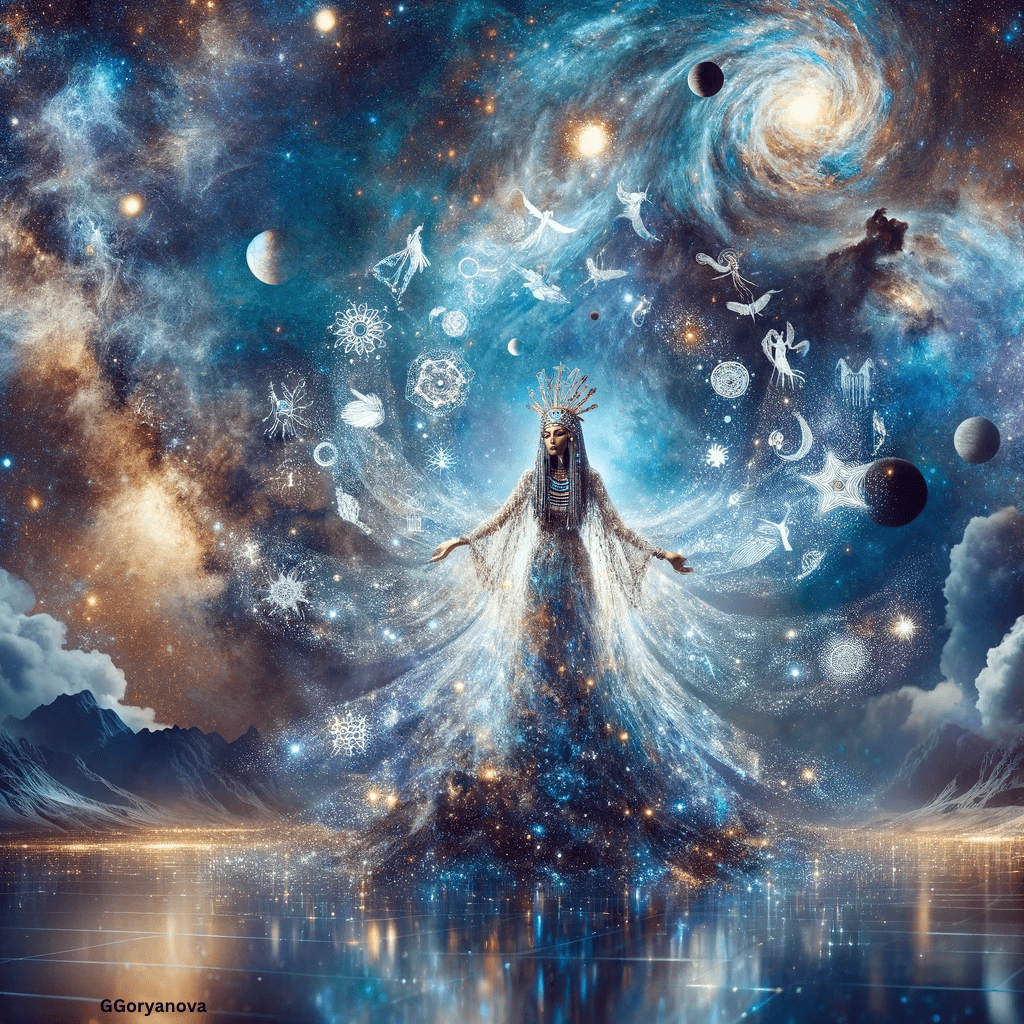
In the grand tapestry of ancient Egyptian mythology, the goddess Nut unfolds in the heavens, embodying the vastness of the sky and the mysteries of the cosmos. As a celestial goddess, she plays a central role in the pantheon, connecting the earthly realm to the infinite space above.
She is often depicted as a woman arched over the Earth, her body adorned with stars and the Milky Way. Her body stretches across the firmament, creating a protective veil shielding the world. She is the mother of the sun god, Ra, and the moon and stars are seen as her children, born each night and reborn each morning.
Her image, swallowing the Sun at dusk and giving birth to it at dawn, symbolizes the cyclicality of time and the eternal renewal of life. Her presence in the heavens marked the passing of hours, days and seasons, serving as a celestial clock that guided the daily lives of the Egyptians.
The role of the goddess extends beyond the dimension of time. She plays a vital role in the afterlife, as it is believed that she will embrace the souls of the departed, giving them protection and guidance during their journey to the realm of the gods. Her outstretched arms give peace and comfort to those who pass into the eternal realm.
The temples and shrines dedicated to Nutt are few, as her domain is the very expanse of heaven itself. Her influence, however, permeates all aspects of Egyptian culture and spirituality: from the intricacies of the calendar, to the symbolism in royal art and architecture.
Isis: Queen of Magic and Motherhood

In the pantheon of ancient Egyptian deities, few figures capture the imagination like Isis, the revered queen of magic and motherhood. Her influence extends far beyond the confines of myth, touching the lives of mortals with a potent blend of love, wisdom, and mystical power.
Isis, with outstretched wings, symbolizes protection and shelter. As the wife of Osiris, she plays a central role in the cycle of life, death and resurrection. Her unwavering devotion to Osiris, even in the face of tragedy, becomes a moving story of the triumph of love over adversity.
Magic
The magical arts are under her control and she uses her powers to heal the sick, protect the vulnerable and guide the souls of the departed. She is a ray of hope for those navigating the turbulent waters of life, offering comfort and miraculous interventions. Every form of magic contributes to its multifaceted role in Egyptian spirituality. Some of her magical abilities are:
Healing magic - She is a skilled healer and her magic is often used to cure illness and injury. She has knowledge of healing herbs and spells that can restore health to those in need.
Magic for protection - As a patron goddess, Isis has the power to ward off evil spirits and protect people from harm. Her magic provides a shield against malevolent forces.
Resurrection Magic - One of her most famous feats was her ability to resurrect her husband Osiris after he was killed by Seth. Her profound magic brought Osiris back to life, symbolizing her control over life and death.
Divination magic - associated with divination and the ability to predict future events. She was believed to possess knowledge of hidden things and could guide those who sought her wisdom.
Shape change - in some myths is said to have the power to change shape, allowing it to move stealthily and achieve its goals discreetly.
Control over the natural elements - it can control the natural elements, such as the wind and the waters of the Nile. She uses her powers to influence the natural world in ways that benefit her worshippers.
Protection of children - She was especially revered as a protector of children. Her magic ensures the safety and well-being of babies and little ones.
Necromancy - In her quest to resurrect Osiris, she demonstrates her mastery over necromancy - the art of communicating with and influencing the spirits of the dead.
In temples dedicated to Isis, priests and priestesses invoke her name in rituals that celebrate life, fertility, and the enduring bond between a mother and her child. The "knot of Isis" (ankh), an ancient symbol representing the eternal bond between life and death, adorns sacred spaces as evidence of her enduring influence.
Osiris: Journey to the Afterlife
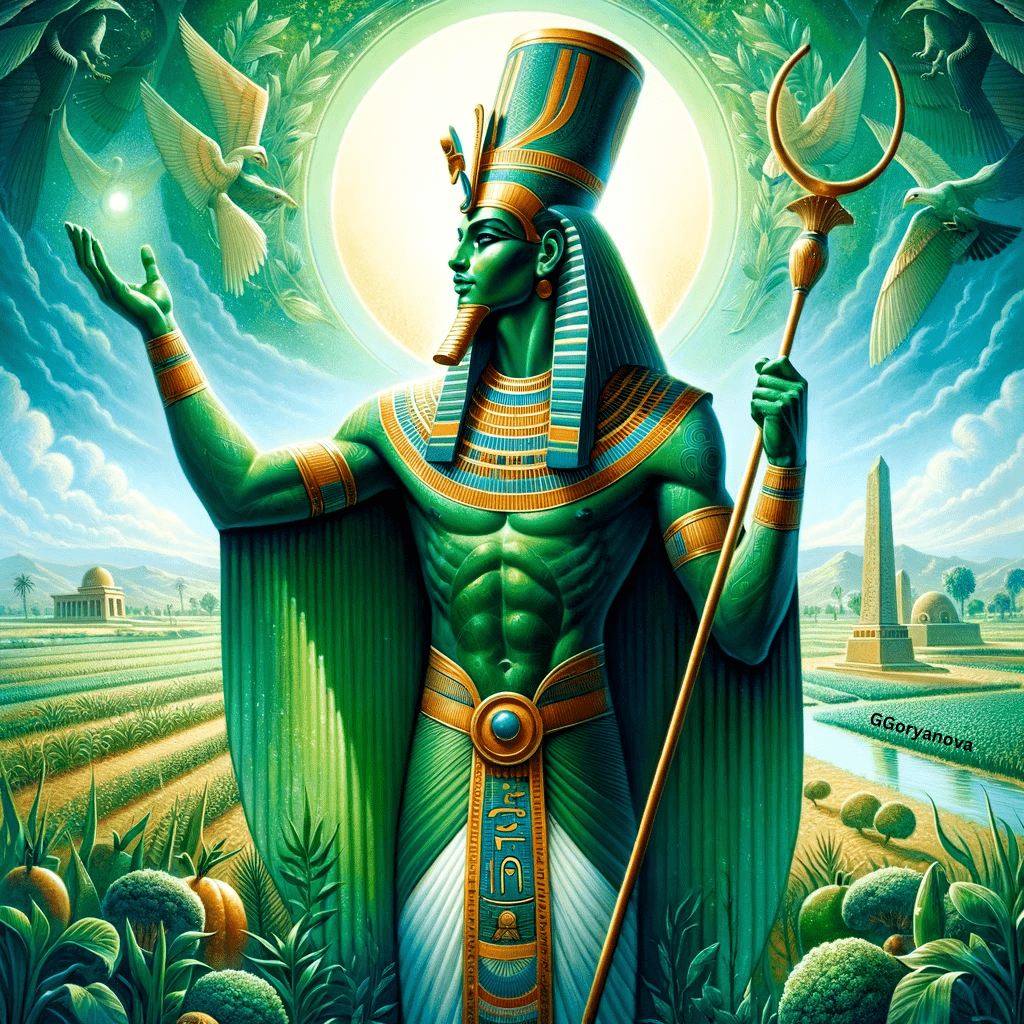
As our journey through the sacred realms of ancient Egypt unfolds, we come to the enigmatic figure of Osiris, the god whose story is woven into the very fabric of Egyptian spirituality. Osiris, the lord of the afterlife, holds the key to the eternal mysteries that await every soul beyond the veil of death.
Osiris was revered for his wisdom, benevolence and sense of justice. Under his rule Egypt flourished and he introduced the arts of agriculture, law and civilization to the land. He taught the people how to cultivate the fertile soil along the banks of the Nile, bringing prosperity to the kingdom.
At the heart of the Egyptian belief system, Osiris guides the judgment of souls in the afterlife. The "Weighing of the Heart" ceremony, in which the heart of the deceased is measured with the feather of Maat, determines one's fate in the afterlife. Those deemed worthy join Osiris in the fields of Aru, a paradise of eternal bliss.
Temples dedicated to Osiris echo with rituals that honor the deceased and secure divine favor for the journey ahead. The grandeur of these structures, adorned with intricate carvings and hieroglyphs, reflects the deep significance of the afterlife in the hearts of the Egyptians.
Resurrection
His story is one of sacrifice, betrayal and resurrection. As the brother-husband of Isis and father of Horus, he embodies the cyclical nature of life and death. His tragic death at the hands of his jealous brother Seth becomes a major myth, symbolizing the inevitability of death and the promise of renewal.
His resurrection symbolizes the triumph of life over death and the promise of rebirth in the afterlife. He became ruler of the realm of the dead, where he judged the souls of the departed and secured their journey to the eternal paradise of Aru, a fertile and blissful land.
Its history highlights the Egyptians' deep beliefs in the afterlife, justice and the cyclical nature of existence. It is a symbol of resurrection, renewal and the enduring power of life over death.
The worship of Osiris and the annual celebration of his death and resurrection became central to Egyptian religious beliefs and funerary practices. The myth of Osiris left an indelible mark on Egyptian culture, influencing concepts of death, rebirth, and the eternal cycle of life for generations to come.
Osiris and Sirius
In ancient Egyptian cosmology, the Nile was the circulatory system of the kingdom and its annual floods were of great importance. The fertile silt brought by the flooding of the Nile enriched the agricultural lands, providing abundant harvests and sustenance for the population. This natural phenomenon is inextricably linked to the cycle of life and death in Egypt. Osiris is closely linked to the annual flood. His role as a deity who brings life and abundance to the earth makes him an integral figure in Egyptian cosmology. The flood is seen as a manifestation of Osiris' power, rejuvenating the soil and ensuring the prosperity of the kingdom.
The heliacal rising of Sirius, the brightest star in the night sky, plays a key role in Egyptian cosmology. This event marked the reappearance of Sirius in the pre-dawn sky just before the first light of the Sun. The Egyptians noticed that the heliocentric rise of Sirius occurred shortly before the annual flooding of the Nile.
The relationship between Osiris and Sirius has symbolic significance. The mythological journey of the god, including his death and resurrection by Isis, mirrors the movement of Sirius in the night sky. When the star disappears from view, he is believed to have entered the realm of the dead, much like Osiris in the afterlife. The reappearance of the star in the eastern sky just before dawn symbolizes resurrection and renewal, reflecting Osiris' own story of rebirth.
Egyptian cosmology emphasizes the cyclic nature of existence. Life and death, darkness and light, chaos and order were part of an eternal cycle. The annual rising of Sirius, which signaled the flooding of the Nile and the subsequent rebirth of the earth, reinforces this fundamental belief in the eternal cycle of life and death.
Choir: God of the Kingdom
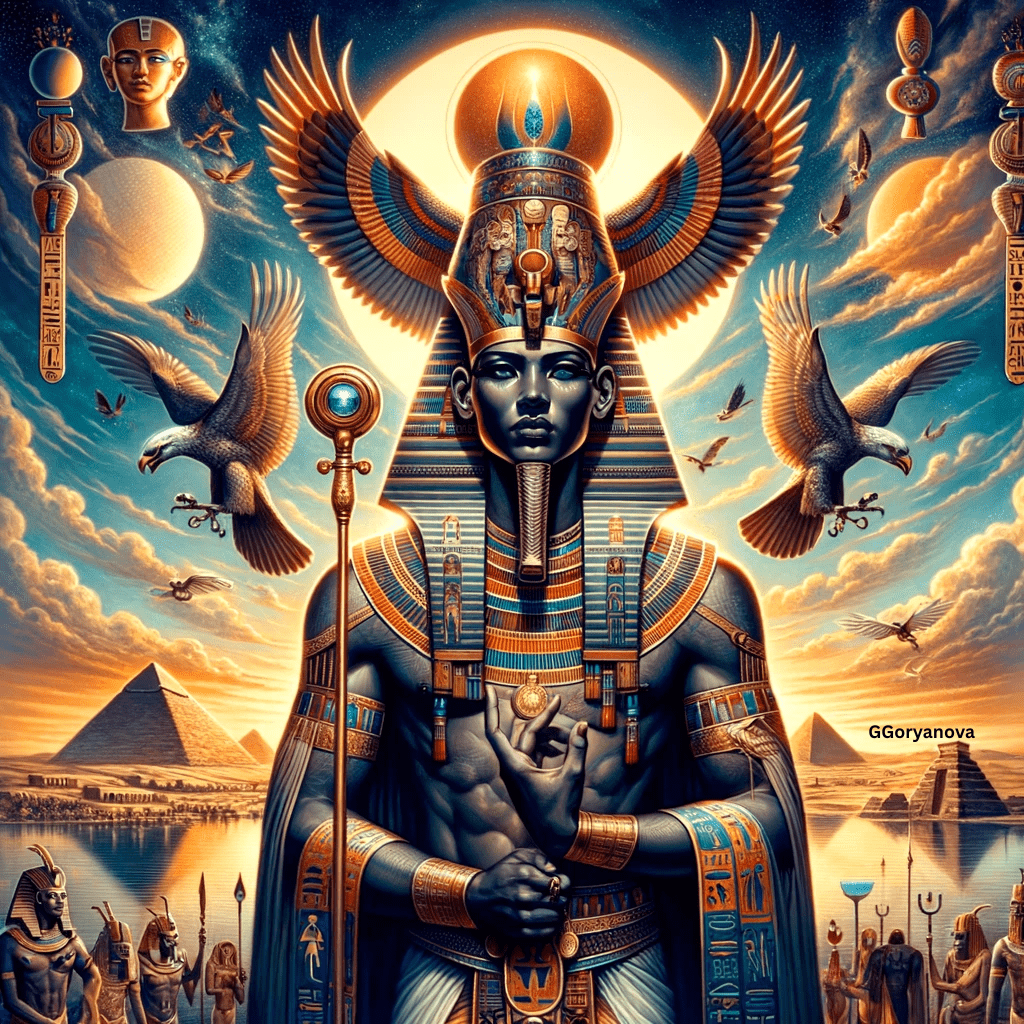
Among the pantheon of ancient Egypt, the majestic figure of Horus, the Falcon God of the realm, rises with regal splendor. He is the divine successor of Osiris and Isis, embodying the ideals of rule, protection and the eternal struggle against chaos.
The falcon, symbol of swiftness and keen vision, becomes his totem, reflecting his watchful guard over the kingdom. The "Eye of Horus," a powerful protective amulet, adorned the living and the dead, a talisman against malevolent forces seeking to disrupt the cosmic order.
His connection with the Pharaohs is deep. Ruling monarchs were believed to be the earthly manifestation of Horus, ensuring the continuity of divine rule. The falcon god became a symbol of both the ruler's power and the unity of the nation under the watchful eye of the divine protector.
In the cosmic struggle against Set, the god of chaos, Horus becomes a symbol of hope and protection. The battles between these two deities reflect the challenges the pharaohs faced in maintaining order and stability in the earthly realm. The concept of "Ma'at," embodied by Horus, stands as a guiding principle for just governance.
Anubis: Guardian of the Underworld

In the sacred realm of ancient Egypt, where life and death dance in eternal harmony, Anubis appears as the solemn guardian of the underworld. With the head of a jackal and a posture of unwavering vigilance, Anubis guides the journey of souls through the afterlife.
Anubis played a central role in the sacred rituals of mummification, guiding the deceased through the elaborate rituals that ensured safe passage to the realm of Osiris. The weighing of the heart against the feather of Maat took place under the watchful eye of Anubis, determining the soul's fate in the cosmic balance.
The jackal-headed deity was not only a guide for the deceased, but also a comfort for the living. Those who remain seek his protection, asking him to guide their departed loved ones to a place of eternal peace. The temples dedicated to him echo with prayers and rituals invoking his favor on both the living and the dead.
The presence of Anubis extends beyond the funerary realm, permeating the cultural landscape of ancient Egypt. As the deity who ushers souls into the afterlife, Anubis becomes a symbol of transition, marking the threshold between the earthly and divine realms.
Maat - Weighing the heart against the pen

In the cosmic order of ancient Egypt, amidst the ebb and flow of life, the goddess Maat stands as the embodiment of truth, justice and divine balance. Her presence is not only a guiding force in the afterlife, but a principle woven into the very fabric of existence.
The symbol of Maat, the feather, represents the delicate balance governing the universe. The Weighing of the Heart ceremony, led by Maat, determines the fate of the departed. The heart, representing the sum of one's deeds, was measured against the weightless feather, symbolizing the purity of the divine order.
The concept of Maat extends beyond the court of the dead. It is a guiding principle for righteous conduct in the earthly realm. Pharaohs, as earthly rulers, seek to uphold Maat in their rule by ensuring that justice, truth, and harmony prevail among their subjects.
The temples dedicated to Maat were centres of moral and ethical education. Her teachings emphasized the interconnectedness of all living beings and the responsibility to contribute positively to the cosmic balance. The goddess's influence reaches into the hearts of people, shaping the moral compass of a civilization that honors the divine order.
Thoth - Scribe of the Gods
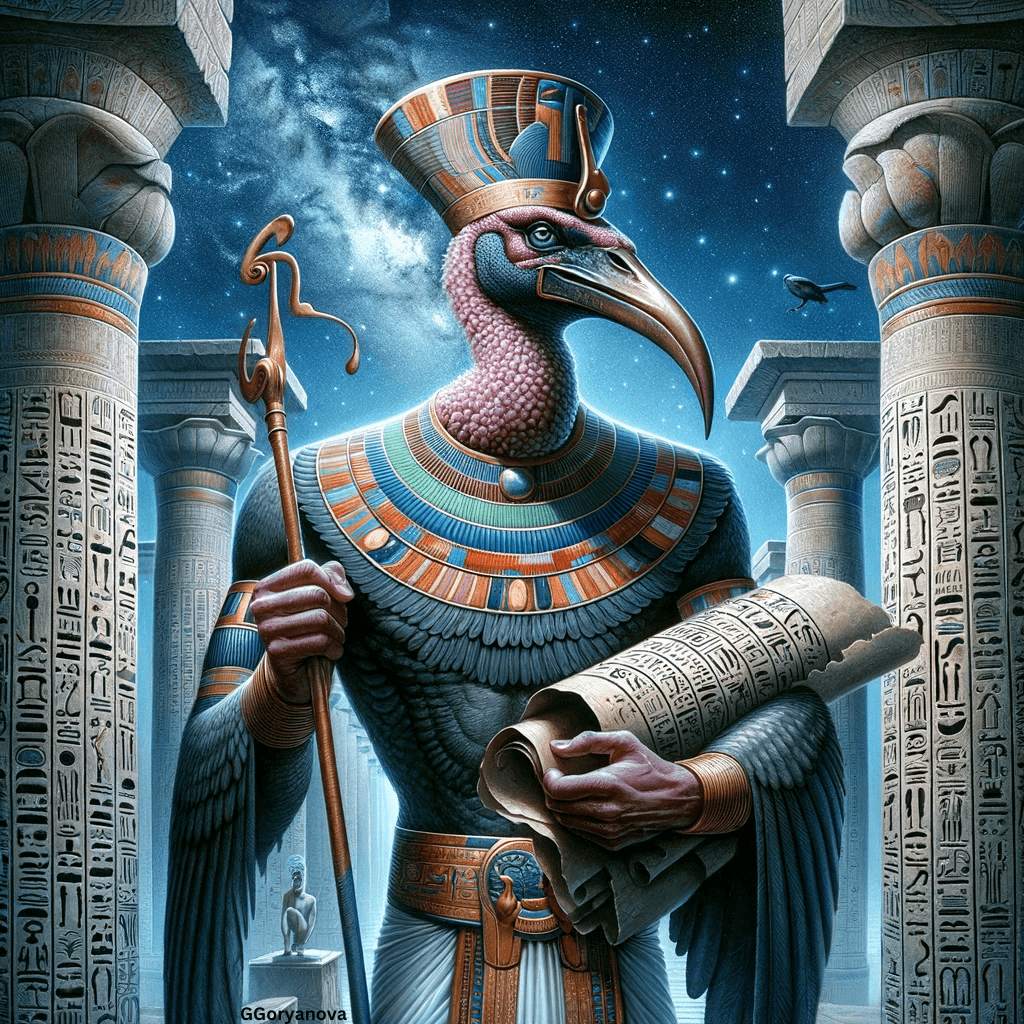
In the hallowed annals of ancient Egypt, among the celestial scribes who chronicled the divine narratives, Thoth appears as the most distinguished scribe of the gods. Ibis head and quill in hand, Thoth's influence extended beyond mere record-keeping, shaping the very fabric of wisdom and knowledge.
Thoth is not merely the recorder of events; he is the arbiter of divine communication, linking the mortal and immortal realms. Sacred texts attributed to Thoth, such as the Emerald Tablets, were repositories of esoteric knowledge, guiding seekers of truth through the labyrinth of cosmic mysteries.
As a mediator between gods and mortals, he plays a central role in the "Weighing of the Heart" ceremony, recording the outcome of the soul's judgment. His wisdom extends to the realms of science, magic, and language, making him a patron of scholars, sorcerers, and scribes.
In temples dedicated to Thoth, priests participate in rituals that seek to invoke God's blessings for intellectual pursuits and divine revelations. The sacred ibis, revered as a symbol of this deity, embodies the pursuit of higher knowledge and the transcendence of earthly limitations.
Bastet - The Feline Protector

In the tapestry of ancient Egyptian polytheism, the graceful figure of Bastet, the Cat Protector, takes her place as the guardian of the home and hearth, a symbol of joy and maternal warmth and strength to be reckoned with in the realm of divine protection .
Bastet, often depicted as a lioness or a woman with the head of a lioness, embodies both ferocity and benevolence. She watches over households, protecting them from evil and misfortune. Her presence is invoked for protection from disease, evil spirits, and other threats that might haunt the home.
The cat, sacred to Bastet, was revered for its protective qualities. Egyptians often kept domestic cats not only as companions but also as living talismans against evil forces. Injuring a cat, even accidentally, was a serious crime punishable by law.
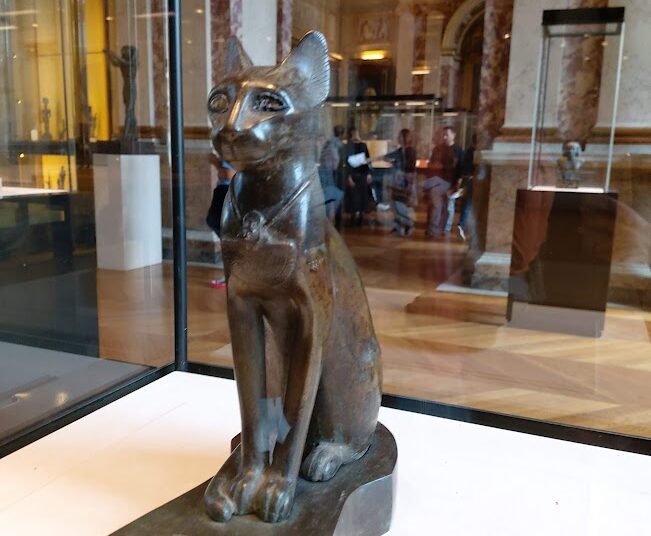
Its influence extends to music and dance, bringing joy and festivity into people's lives. Its festivals are marked by lively celebrations where music, dance and merriment create an atmosphere of community unity and spiritual renewal.
Temples dedicated to Bastet echo with the purrs of contented, feline companions. Devotees seek her blessings, offering votive statues and amulets in gratitude for her protective watch over their homes and families.
Seth - Chaos and order in unison
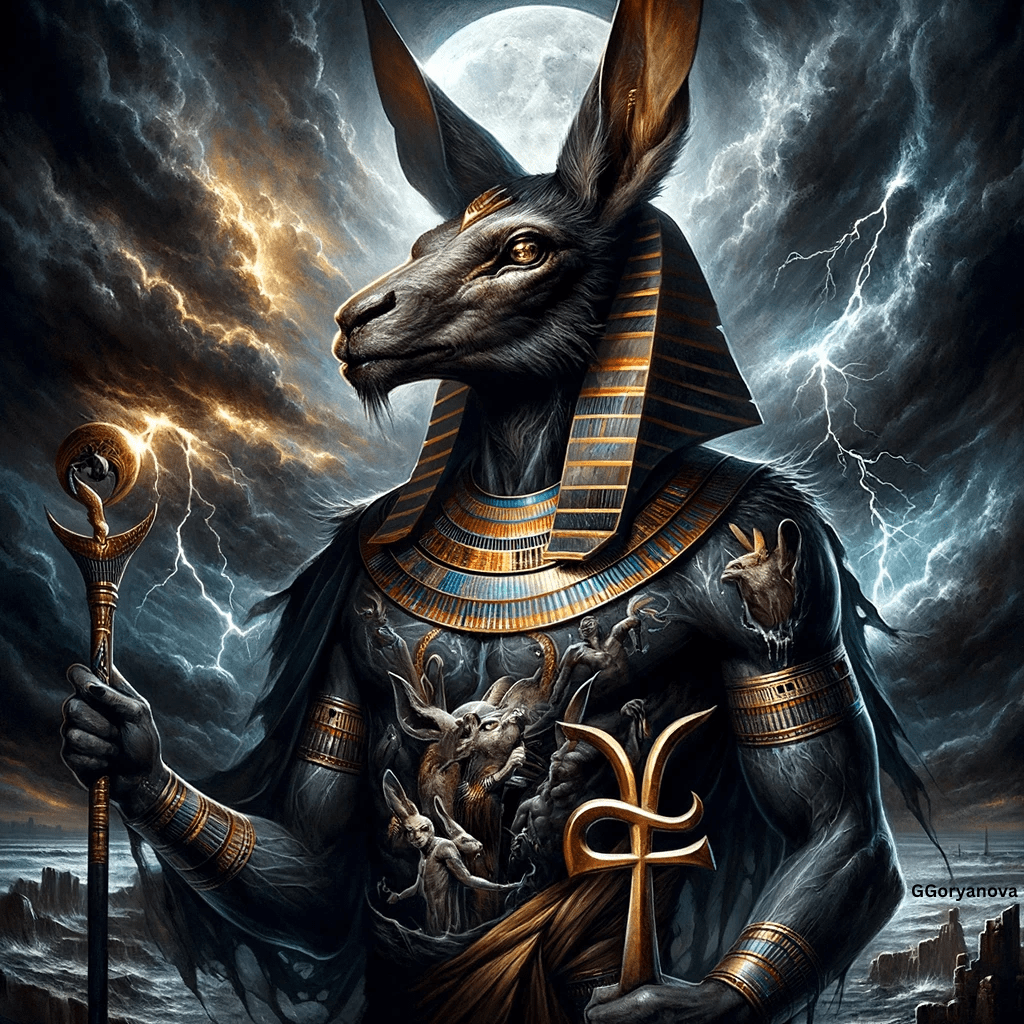
In the complex tapestry of ancient Egyptian polytheism, Set stands as a figure at once enigmatic and powerful, embodying the duality of chaos and order, destruction and protection. Set's presence in the pantheon serves as a reminder that the balance between opposing forces is fundamental to cosmic order.
It is often depicted with the head of a mysterious creature and defies easy categorization. He is a god of the desert, storms and chaos, sometimes depicted as a force of turmoil. Yet, he has a protective aspect, guarding Ra during his nocturnal journey through the underworld.
Mythological narratives surrounding Set often involve conflicts with other deities, especially Horus and Osiris. These tales symbolize the constant tension between competing forces in the natural and supernatural realms. Seth's tumultuous relationships with other gods reflect the delicate balance between chaos and order in the Egyptian worldview.
Despite his complex nature, Seth occupied a place in the pantheon and his worship was not uncommon. Temples dedicated to Set existed, especially in desert regions where his protective attributes were revered. Rituals and offerings sought to appease this unpredictable deity, preventing his erratic tendencies from wreaking havoc.




 English
  Bulgarian